
Shipowner Dr. Nikolas Tsakos Joins Panel Discussion on The Effects of Hormuz Crisis on The Global Energy Supply Chain
by Athena Efter
The Strait of Hormuz crisis and its effect on the world’s energy supply and economy was the topic of the day at Columbia Business School’s panel discussion on “The New Art of Energy War” at Reed Smith in New York City. Hosted by attorney Niovi Christodoulou, Chair of the Global Business and Tech Committee of the Columbia Business School Alumni Club, the event featured prominent speakers such as Dr. Nikolas Tsakos, the prominent Greek shipowner and CEO of Tsakos Energy Navigation, Ltd. as well as several other experts on both global energy policy and investment. Moderated by energy consultant Yavuz Arik, the discussion provided some insightful observations by all those participating.
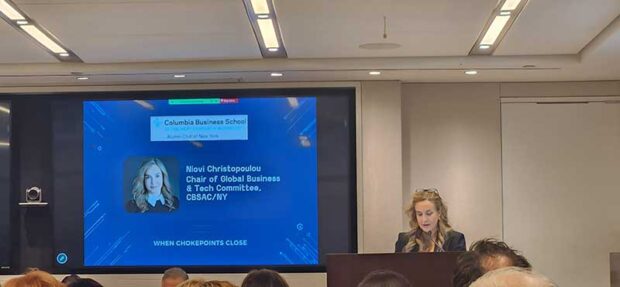
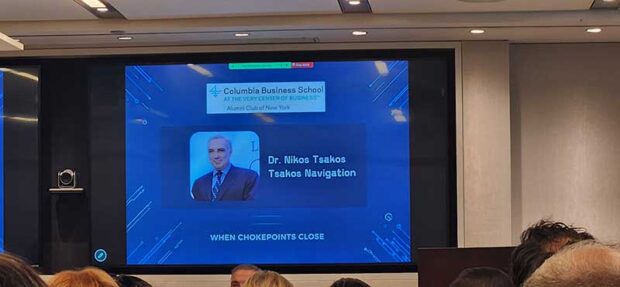
The discussion began with a question on the immediate pragmatic consequences of the supply and demand disruption. Dr. Tsakos explained that the cost of energy transport is based on the cost of the product delivered. Since the crisis began it has gone up fivefold. Especially notable since 60 percent of the world’s oil is moved by sea. He mentioned a current workaround in which his ships could dock in Syria and thousands of trucks could then move the oil to Europe.
The next question revolved around how producers of energy have been affected by infrastructure beyond their control. To which, Alex Whittington, an executive at Cheniere Energy, one of the US’s largest natural gas suppliers said every node along the supply chain has vulnerabilities, but, being that the US is the world’s largest natural gas supplier, the affect has been minimal since natural gas moves across the Atlantic to Europe.
The panel conceded that the current crisis makes for some tumultuous times because of the one-two punch of the capture of Nicolas Maduro in Venezuela, as well as the war with Iran. That a shortage of 20 million barrels a day could lead to a one billion-barrel disruption in the aggregate. There’s also a larger disparity in how refiners see the crisis as opposed to Wall Street, which could lead to unpredictable fluctuations in the markets.
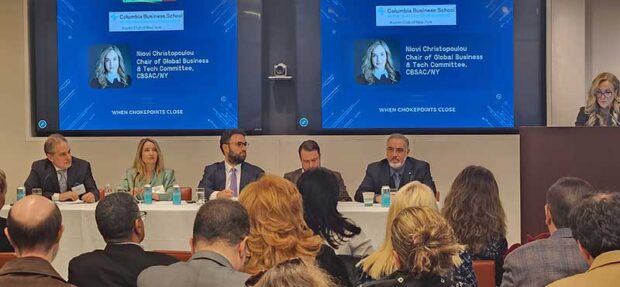
As the topic moved onto the Qatar LNG (liquefied natural gas) plants that were damaged in the Iran war, there was a conclusion that about 17 percent of the world’s LNG production would be wiped out at the outset. Dr. Tsakos said that pragmatically there would be no “winners” from that crisis because the demand for renewable energy has been very elastic over the past two decades. He added that things will fluctuate in an environment where renewables are promoted in lieu of fossil fuels and that “losers” could be those who, ironically, invested in greener LNG investments.
Whittington also added that the big loser in the crisis is South Asia: India, Pakistan, and Bangladesh, and that Europe would be much less affected since it only imports about the 3 percent of the total gas supply. The biggest risk to LNG is the long term demand in Southeast Asia, and it is further complicated by the fact that no one knows when the conflict will end. Diego Rivera Rota, of Columbia University’s Center on Global Energy Policy agreed with the panel and added that rising prices would affect Southeast Asia because other products, such as fertilizer which is dependent on LNG for production, will face severe inflation. He also mentioned that in the immediate timeframe Russia is in a good position because the sanctions were lifted. Other beneficiaries would include coal producers. He mentioned that China was in a unique position because of its infrastructure to function more and more on renewable energy.
Olga Khakova of the Atlantic Council’s Global Energy Center, also agreed with the panel, but indicated that the bigger existential threat of a “loser” in all of this could really be the climate and pointed out the ecological calamity that could result. She also added how all other industries are affected by this disruption. If fertilizer supply is affected so then is the global food supply chain, she added as ready example.
Tsakos emphasized that one of the residual effects of the closing of the Strait of Hormuz has been the spike in insurance premiums which went up to five percent per the value of the cargo. It’s also complicated insurance on crew safety which has already gone up because of Houthi pirates who’ve prompted rerouting through the Suez Canal. When asked about US-Greek relations during the current crisis, Tsakos stated that the current war in the Ukraine has forced Europe to find LNG suppliers from across the Atlantic which has been beneficial to Greek shipping companies. He also mentioned, however, that the US may start building ships again, but that would be a very long term project to actualize. Whittington added that there has been increased investment in Asia to build cargo ships, especially in South Korea.
The discussion then moved on to global policy and the role of shipping in the policymaking arena. Tsakos stated that because shipping tends to have a much smaller seat at the table because the industry is both viewed as unglamorous and is mostly controlled by private companies, but a growing number such as his own company, TEN Ltd., are on of the dozen or so to be publicly traded. Whittington further added that governments are still unsure of how to react to the crisis because of the volatility of the situation and its ripple effects on elevated prices across the globe on all products dependent on oil and LNG. He also mentioned that the US, the world’s largest natural gas supplier, tends to have relative independence as the American government doesn’t interfere with its business model. The panel also agreed that Europe needs to establish ways of creating its own LNG procurement strategy by potentially creating a “buyer’s club” which could be beneficial to all parties along the supply chain.
The panel then discussed the future of renewable energy and how that may or may not be jumpstarted by the Hormuz crisis. The speakers agreed that for several regions such as South America and China there’s been a better infrastructure to create a baseline for renewables, but Tsakos stated that a well-developed transition to renewable energy would be a long time away and that the best strategy would be to maintain the current supply of fossil fuels and natural gas to allow the time for that infrastructure to be built.
Finally, the discussion ended with a talk about both what the future holds and what China’s position in it is. Tsakos said that shippers simply want to do their job with “toll free” roads and no tariffs and that the expectation of a peaceful resolution to the conflict would take at least six months for the global supply chain to normalize and have prices come down to pre-crisis levels. He added that shipping is still the most environmentally friendly way to move energy supply around the world and that the current rates, if they continue, could become unsustainable. He also remarked that China’s exposure to the crisis has been less than expected because of their self-sufficiency and the State purchases of significant reserves.
Ms. Christodoulou thanked Dr. Tsakos and the other guests for their participation and concluded the talk by emphasizing that the chokepoint at the Strait of Hormuz has made clear the domino effect of vulnerability on the multilayered systems that are in place which keep the world’s energy supply moving. That, in a way, it would have the positive effect of preparing for future crises by understanding all the moving parts that are affected and coming up with viable solutions at every point in the supply chain.










0 comments