
America celebrates its founding and how Greece made it possible
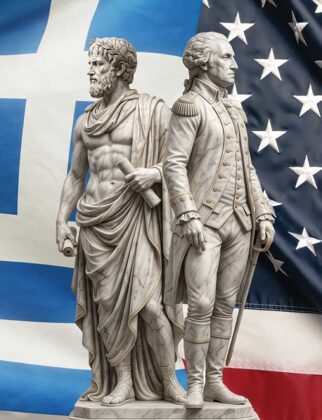
When Thomas Jefferson sat down to write the Declaration of Independence in June of 1776 in a rented house in Philadelphia, the seminal inspiration he took was from the countless books of ancient authors that filled his library back in Monticello, which he read in the original Greek.
“The Greeks by their laws, and the Romans by the spirit of their people, took care to put into the hands of their rulers no such engines of oppression as a standing army. Their system was to make every man a soldier, and oblige and repair to the standard of his country whenever that was reared. This made them invincible, and the same principle will make us so.”
He considered himself an Epicurean and a Stoic, who believed in moderation, virtue and the pursuit of happiness (in the Declaration: “Life, liberty, and the pursuit of happiness”).
He believed in the Greek ideal that all power must be limited, checked, and be held accountable, and that the polis was the perfect model for civic virtue and citizen participation.
“The course of history shows that as a government grows, liberty decreases. So let us tie (government) down with the chains of the constitution so (it) does not become the legalized version of (criminality).”
He studied Thucydides, Herodotus, and Plutarch not as historians, but as political guides. He believed their accounts of tyranny, corruption, and democratic decay were essential lessons for America.
He also considered ancient Greek architecture as the embodiment of reason and built his home on classical lines, and also the buildings of the University of Virginia, which he founded, as symbols of the new republic’s connection to ancient ideals of reason, balance, and civic virtues.
Jefferson saw the new American republic not as a copy of Rome, but as a rebirth of the Greek polis, where free citizens shape their own destiny.
He was the founder who looked at America and saw Athens rising again.
George Washington himself believed in the Stoic virtues of self-control, duty, and moral discipline. He saw leadership as a burden, not a prize—a deeply Greek idea. When he resigned his commission after the war, Americans compared him to Cincinnatus—but Washington’s private writings show he was equally drawn to the Greek ideal of the leader who serves reluctantly, with humility. He believed, like the Greeks, that character is the foundation of a republic. He prided himself on the ancient Greek virtue of sophrosyne—self‑control.
John Adams quoted from Thucydides, Plutarch, and Demosthenes like modern politicians quote polls and echoed the ancients when he wrote that republics survive only when citizens cultivate virtue. He believed a democracy without virtue would collapse—a lesson drawn straight from Athens.
Like the Greeks, he felt that freedom survives only when citizens are educated, vigilant, and morally grounded. And he saw the Revolution as a chance to prove that the lessons of ancient Greece had not been forgotten.
James Madison studied Greek political failures—factionalism, demagoguery, mob rule—when he wrote the Constitution, where he argued that power in a republic must be divided to avoid tyranny. From these lessons he built the American system of checks and balances, a structure designed to prevent the very dangers that had shattered ancient democracies. Madison imbued the American constitution with the lessons learned from Athenian democracy.
Alexander Hamilton admired the Greek emphasis on strong civic institutions. He read Greek historians to understand how weak governments fall prey to chaos and foreign influence. He believed, like the Greeks, that a republic must be energetic, organized, and capable of defending itself. His arguments for a strong central government echo the Greek belief that liberty requires structure, not just passion. Hamilton saw in Greece a warning: freedom without order is short‑lived.
So, it was ancient Greece that provided the intellectual framework for the American Revolution and the government that followed: the American founding fathers, fighting tyranny and for their freedom, built their new nation on the model of the oldest democracy in history and the belief that freedom is the natural state of mankind.
And the few Greeks who lived in the colonies at the outbreak of the Revolution put their lives on the line to fight in the battlefields of the new freedom.
Around 1768, a Scottish doctor named Andrew Turnbull decided to build a plantation in British East Florida and he wanted workers that were tough, sun-hardened and could till unforgiving land. So, he went to Greece and other Mediterranean countries and gathered hundreds of hopeful souls, with more than 500 Greeks among them from Mani and Crete and the other islands.
They thought they were starting a new life and they were promised land, wages and freedom.
But what they got were hardship and oppression. They soon discovered they were slaves, not workers. They planted indigo, they dug canals, they built roads, they survived hurricanes and disease—working from dawn to dusk in the blistering sun, and soon buried countless of their compatriots.
But, somehow, with the hardiness of Greeks, they survived this oppression for nine years, and then in 1978 the surviving settlers escaped 70 miles north to St. Augustine and appealed to the British governor there.
Miraculously, he freed them, and that’s where they settled and
formed the first Greek Orthodox community in America, establishing the Avero House chapel (now the St. Photios Shrine), and though small in numbers, they might have fought at the Battle of Monmouth in 1778 under Demetrios Ypsilanti.
Who led the Greek Revolution fifty years later, and in turn took inspiration from the American Revolution.
And the Greek thread continues to America’s second great conflict in the American Civil War, when Abraham Lincoln wrote his Gettysburg Address as a dedication to the fallen.
At its core, it is built on the bones of a much older speech: Pericles’ Funeral Oration. Modern scholarship shows that Lincoln consciously echoed the structure, themes, and rhetorical strategies of Pericles’ address, delivered in 431 BCE during the Peloponnesian War.
Both speeches begin by invoking the ancestor. Pericles opens by praising the ancestors who built Athens and preserved its freedom. He frames the fallen soldiers as heirs to a noble lineage.
Lincoln mirrors this:
“Four score and seven years ago our fathers brought forth on this continent a new nation…”
This parallel is not accidental. Scholars note that Lincoln is following the epainesis structure — praise of the ancestors — that Pericles used.
Then both speeches transform the dead into symbols of democratic ideals.
Pericles argues that the fallen Athenians died not just in battle, but for the idea of Athens — its democracy, its freedom, its way of life.
And Lincoln echoes that: the Union dead become martyrs for the proposition that “all men are created equal.”
Garry Wills, in Lincoln at Gettysburg, shows that Lincoln used Periclean logic:
The dead sanctify the nation. Their sacrifice gives the living a moral duty. The battlefield becomes sacred ground.
And both speeches use contrast and antithesis to elevate meaning.
Pericles’ oration is famous for its antitheses — pairing opposites to create moral clarity. Lincoln does the same: “The world will little note, nor long remember…”
“…but it can never forget what they did here.” This rhetorical strategy is directly linked to the Greek funeral‑oration tradition.
Both speeches also redefine the purpose of the war. Pericles uses the funeral to remind Athenians why they fight — to preserve democracy. Lincoln uses Gettysburg to redefine the Civil War as a test of whether any democracy can survive.
So, both speeches turn mourning into political meaning, elevating grief into civic purpose. And both are structured as an epitaphios logos, which is traditional structure of an Athenian funeral oration: Praise of ancestors. Praise of the dead. Praise of the city and its ideals. Moral instruction to the living.
Lincoln compresses this structure into 272 words — but the architecture is unmistakably Greek. Everett, the main speaker at Gettysburg and a classical scholar, explicitly modeled his own speech on Pericles — and Lincoln, speaking after him, distilled the same form into something immortal.
Finally, both speeches universalize the meaning of sacrifice.
Pericles says: “The whole earth is the sepulcher of famous men…”
Lincoln echoes the idea that the dead belong not just to their families, but to history, and that their sacrifice demands the living continue the work:
“…that government of the people, by the people, for the people, shall not perish from the earth.”
This is the Periclean move: turning the fallen into guardians of democracy.
And memorably, both speeches elevate the nation through sacred language. Pericles speaks of Athens almost as a sacred ideal. Lincoln sacralizes the American experiment, calling the nation “conceived in liberty” — a birth metaphor straight out of classical rhetoric.
Pericles stood before Athens and said: “These men died for the idea of our democracy.” Two thousand years later, Lincoln stood on a Pennsylvania battlefield and said: “So did these men.”
And Lincoln took his inspiration from Pericles — and from the oldest democratic funeral tradition in the Western world to create a speech that sounds both ancient and modern at the same time.
The Greek influence even inspired the vast and beautiful “rural cemeteries” that were built during the 19th century.
Before Mount Auburn, Green‑Wood, Laurel Hill — the dead were buried in cramped churchyards, crowded plots behind meetinghouses, places where bodies were stacked, stones leaned, and the living hurried past with their collars turned up.
But in the early 1800s, Americans began to look backward to the ancient world. To Athens, where the Kerameikos stretched like a marble‑lined avenue of heroes. And where the dead were honored with sculpture, gardens, inscriptions, and the belief that memory should be beautiful.
And Americans asked: Why should our dead not rest in beauty too?
In ancient Greece, cemeteries were not hidden. They were public, open, walked through, visited, admired. The Kerameikos in Athens was a place of sculpted stelae, shaded paths, olive trees, family monuments, public memory. It was a place where the living went to reflect, to honor, to learn. And the Romans had continued this tradition. Their tombs lined the roads leading into the city — a reminder that the dead were still part of the civic world.
This idea — that the dead deserve beauty, space, dignity, and public presence — struck American thinkers like a revelation. Urban reformers, artists, architects, and physicians began to argue that America needed something better — something classical.
The spark was Mount Auburn Cemetery (1831)–the first rural cemetery in America. Mount Auburn in Cambridge, Massachusetts was explicitly modeled on ancient Greek and Roman burial landscapes. Its founders modeled it on the Kerameikos and introduced classical sculpture in it and the ancient idea of the cemetery as a place of moral instruction.
They included a garden, museum, sanctuary, school of virtue, and the Periclean precept that the dead ennoble the city.
The movement spread to the establishment of Green‑Wood Cemetery in Brooklyn (1840), where its founders spoke of Greek ideals of beauty, included classical architecture, showed the moral power of landscape, and made the cemetery a civic monument.
In this spirit, Green‑Wood became a park before parks existed, a museum before museums existed, and a pilgrimage site before tourism existed. It was America’s Kerameikos — a place where the living walked among the dead and felt elevated by them.
You can walk through Mt. Auburn or Green-Wood and see obelisks (which had been adopted by Greece and Rome), temples. columns, urns, laurel wreaths, draped Greek figures, sarcophagi modeled on ancient prototypes.
It was a deliberate revival — a belief that classical forms ennobled the dead and uplifted the living. A revival of the ancient ideal that death is part of life, memory is a public duty, beauty consoles, nature heals, the dead teach virtue.
Which, in fact, is the same philosophy behind Pericles’ Funeral Oration — the idea that the dead are not lost; they are woven into the moral fabric of the city.
The cemeteries were, in fact, a classical revival, a rebirth of the ancient belief that the dead deserve beauty and the living deserve places where memory can breathe.
Mount Auburn and Green‑Wood became America’s Kerameikos and a quiet, profound tribute to the ancient world.
And like their forebearers in New Smyrna, American Greeks fought and died in American battlefields.
More than 25,000 Greek Americans enlisted in World War II (out of a Greek community of 200,000) and fought in every theater from Normandy to the Pacific.
And the U.S. Merchant Marine was overrepresented by Greeks, who carried on their seafaring tradition. They were the backbone of the Merchant Marine fleet that delivered supplies over U-boat infested waters. Which is why their casualty rate was the highest of any American service.
Among Greek American war heroes were Lt. Col. James Megellas, the most decorated officer in the history of the 82nd Airborne. Michael Stratikis, who won the Navy Cross. Peter Tomich, who won the Medal of Honor and died saving his comrades in Pearl Harbor. And Steve Pisanos (“The Flying Greek”), who was an ace pilot in the Air Force.
And even before that, they had fought in the trenches of World War I, the Spanish American War (again becoming a mainstay of the Navy and Marine Corps) and the Civil War, on both sides. George Colvocoresses, a Greek orphan rescued by an American naval officer, went on to become a Union commander.
And in peacetime, Greeks have made their own contribution to the America that we know.
Ted Leonsis built AOL, Nicholas Negroponte built the MIT Media Lab and foresaw the media world that we know today, Peter Diamandis thought of space and created the X Prize, Dr. Stamatios Krimigis built many of the rockets that took us to space, Michael Dukakis ran for president, Spiro Agnew became vice president, Maria Callas became the diva of divas, Dr. George Papanicolaou created the Pap smear and saved millions, Dr. Lia Merminga of Fermilab became a leader in particle physics, Dr. George Yancopoulos a biotech pioneer, Harry Mark Petrakis became the bard of Greek immigrant life, Nicholas Gage the chronicler of his mother’s sacrifice in Greece and rebirth of her family in America, Eleni Gage went back to Greece to chronicle her own communion with her grandmother and family history, and Jeffrey Eugenides put a modern spin on the Greek American experience.
Not to mention how Greek Americans have transformed business in America. Jamie Dimon runs JP Morgan Chase with $4.4 trillion in assets, Peter Angelos owned the Baltimore Orioles, Alex Spanos the Los Angeles Chargers, Ted Leonsis the Washington Wizards, John Paterakis made all the buns for McDonalds, Leo Stefanos invented the Dove bar, Paul Mitchell cosmetics was co-founded by John Paul DeJoria, whose mother was an immigrant.
And with their success comes philanthropy: John Pappajohn has donated over $100 million to charity, including scholarships for Greek American students, George Marcus has funded universities, hospitals and Greek studies programs, George D. Behrakis, among other charities gave $10 million to the Museum of Fine Arts in Boston to fund exhibits of ancient Greek, Roman and Egyptian civilizations.
Not to mention the Greeks in entertainment (Zach Galifanakis, Jennifer Aniston, John Stamos, Rita Wilson, Tina Fey, Nia Vardalos, Billy Zane among others) and politics (Paul and John Sarbanes, John Brademas, Charlie Crist, Gus Bilirakis, Chris Pappas, Eleni Kounalakis among others), with six seats in the House, five statewide offices, 12 state senate seats, and 19 state assembly seats.
The celebration of America’s 250th Anniversary is also the celebration of the many ethnic groups that have created the American mosaic and none has been as vital as the Greek American community.
And President Prokopis Pavlopoulos of Greece paid them their tribute:
“The story of Greeks in America is one of courage, dignity, and quiet triumph. They carried with them the values of our ancient democracy and, through hard work and integrity, helped strengthen the democracy of their new homeland. In every field—science, business, the arts, public service—Greek Americans have honored both nations. They remind us that Hellenism is not only a heritage of the past, but a living force that continues to enrich the United States and inspire the world.”

Related Posts











0 comments