
Aristotelis Moumas and The Face of America
by Dean Kalimniou
Every festive gathering in our family has its invisible guests. Some arrive in the form of stories. Others emerge from photographs passed from hand to hand across the table. A few inhabit recipes whose origins have long since been forgotten. Among them all, however, there is one presence whose arrival is so inevitable that it has acquired the force of ritual. No chair is reserved for him. No toast is offered in his honour. Yet sooner or later, usually somewhere between the second helping and dessert, his name enters the conversation and remains there, hovering over the proceedings like incense.
The path by which he arrives is almost always the same. My mother begins recounting her favourite Christmas. Long before I understood who he was, I knew that somehow he belonged within that story, although it would take many years before I understood precisely why.
Every family possesses a foundational story, a narrative repeated so frequently that it eventually ceases to belong to any one individual and instead becomes part of the family’s collective consciousness. Ours takes place in Perama, beside the waters of Lake Pamvotis, Epirus at a time when poverty was not regarded as an unfortunate circumstance but rather as one of the ordinary conditions of existence, accepted with the same resignation as winter rain, political instability or the certainty that life would demand far more than it would ever return.
Repeated so often that every gesture accompanying it has become part of family folklore, the story ought by now to have exhausted its emotional power. Familiarity, however, has achieved precisely the opposite. Certain pauses have become as important as the words themselves. A fleeting expression crossing my mother’s face can evoke an entire vanished world. Memory, gathering momentum with each retelling, carries us away from suburban Melbourne and deposits us once more in a small house overlooking the lake, where a ten-year old girl sits weeping on Christmas Day.
Across the village, preparations for the feast are underway. Smoke rises from chimneys and drifts across the water. Children move excitedly between houses. Somewhere, meat soup simmers in a pot. Decorations fashioned from coloured paper transform humble rooms into places of celebration. Christmas has arrived. It has simply neglected to visit my mother’s house.
Seated beside the stove, my great grandmother watches fragments of ash rise from the embers towards the rafters before disappearing into the darkness above. Her granddaughter sits on the floor crying. Hunger contributes to her distress, though it is not hunger alone. Children possess an acute sensitivity to exclusion. The knowledge that Christmas is occurring everywhere else while somehow bypassing one’s own home is almost impossible to bear.
Neither grandmother nor granddaughter knows precisely when my great aunt will return from work. From time to time, the child wanders to the doorway and gazes along the road before retreating once more into the room. Outside, evening is beginning to settle upon Lake Pamvotis. Beyond the mountains enclosing the basin, beyond Athens and beyond the Atlantic itself, an envelope has already completed most of its journey. Oceans lie behind it. Only the village road remains.
When the door finally opens, my great aunt enters carrying a parcel. Within it are rice and two beef stock cubes. To most people, such provisions would scarcely constitute a Christmas feast. To the occupants of that house, they represent abundance. Purchased with money sent from America, they transform despair into possibility. Yet what follows is what secured a permanent place within family memory.
Producing several sheets of butcher’s paper, my great aunt begins attaching them to the rafters. For the first time in many months, the room possesses a ceiling. Gathering the remaining scraps together, she folds and refolds them before attacking them with a pair of scissors. Soon, intricate patterns emerge. Unfolded once more, the paper resembles lace. Carefully arranged throughout the room, the decorations alter the entire atmosphere of the house. Looking back across the decades, my mother remembers those decorations with greater clarity than the meal itself. The rice was consumed, the stock cubes dissolved. Beauty lingered.
Christmas, such as it was, had arrived from America, thanks to my great-grandmother’s cousin, Aristotelis Moumas.
Long before I met Aristotelis Moumas, I knew him. Not in the ordinary sense of knowing someone, but in the manner one knows a landmark whose presence is so constant that it eventually becomes inseparable from the landscape itself. Stories concerning difficult years invariably drifted towards him. Recollections of the village frequently arrived at his name. A parcel would appear in one story. Assistance would emerge in another. Elsewhere there was mention of clothing, opportunities or quiet interventions undertaken without fanfare. Although physically absent, he seemed curiously omnipresent, inhabiting family memory with an intensity that many of those who remained in the village never achieved.
Perhaps this is because Aristotelis belonged to a generation for whom migration did not imply departure. Crossing an ocean did not require severing one’s connection to the place left behind. Distance altered geography. It did not necessarily alter allegiance.
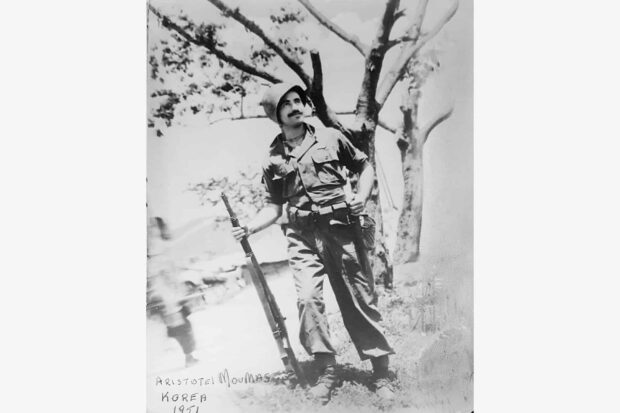
Born in Perama, he left Greece in 1946. Even before embarking upon that journey, history had already demanded much from him. As a youth leader in EPON, the youth movement associated with EAM, he participated in efforts to obstruct Nazi vehicles transporting the Jews of Ioannina. Service to others appears to have come naturally. The instinct accompanied him across the Atlantic.
Military service followed migration. Fighting with the 24th Infantry Division during the Korean War, he earned four Bronze Stars together with the Korean Service Medal and the United Nations Service Medal. Peace introduced another chapter. Establishing the Country Squire Diner in Atlantic City in 1963, he built a successful business and became deeply involved in civic life. Membership of the Morris Guards of Atlantic City, participation in local politics and engagement with community affairs all reflected a personality incapable of remaining on the sidelines.
What distinguished Aristotelis was not merely that he prospered. Thousands of migrants prospered. Nor was it that he remembered the village from which he came. Memory alone demands little. Rather, he appears to have possessed an instinctive conviction that success carried obligations. Prosperity enlarged responsibility. Achievement created duties.
Thus money continued finding its way back to Perama. Clothing arrived as well. At one point, three container loads were shipped for distribution amongst families in need. During Desert Storm, more than one hundred thousand boxes of homemade cookies, amounting to over three million individual cookies, were dispatched to American servicemen and women stationed in the Middle East. Reading through such accounts, one gains the impression of a man for whom generosity was less an occasional virtue than a permanent disposition.
When I finally encountered him in Perama, reality somehow exceeded expectation. Already in his eighties, he possessed an energy that rendered age almost irrelevant. What struck me most, however, was his resemblance to my great-grandmother. Standing before me was a face that appeared simultaneously familiar and unfamiliar, as though some branch of the family tree had travelled across the Atlantic, acquired an entirely different history and then returned bearing stories from another world.
Having grown up hearing of his generosity, I kissed his hand and thanked him for everything he had done for my family. Embarrassment flickered briefly across his face. A warm embrace followed. Moments later he was peppering me with questions because he was not entirely certain who I was. Then this spry octagenerian (we are all long lived in my family) swooped past me, executing the moves of a virile zeimbekiko. The exchange remains among my most treasured memories.
This year, the United States commemorates two hundred and fifty years of nationhood. Others will celebrate that anniversary through parades, speeches and commemorations. My own thoughts travel elsewhere. Before America existed for me as a political entity, it existed as a relationship. Prior to encountering it in books or public discourse, I encountered it through the life of Aristotelis Moumas. Through him, I first came to associate America with energy directed towards achievement, prosperity tempered by generosity, patriotism expressed through service and a profound sense of obligation towards one’s fellow human beings.
As the years pass, I find myself thinking less about the rice, the stock cubes or even the decorations fashioned from butcher’s paper and more about the extraordinary chain of relationships that made that Christmas possible. Somewhere beyond the mountains enclosing the basin of Ioannina, beyond Greece itself and beyond the Atlantic Ocean, a young villager from Perama had entered a world immeasurably larger than the one he left behind. Military service, commercial success, civic engagement and public life would all follow. Yet for all the distances he travelled and all the identities he acquired, some essential part of him appears never to have departed the shores of Lake Pamvotis.
Whenever my mother tells her favourite Christmas story and memory carries us back once more to the little house beside Lake Pamvotis, my thoughts return to the man who made that evening possible. For a Greek born and raised in Melbourne, Aristotelis Moumas remains the most persuasive expression of what America at its best can be: energetic, generous, patriotic, civically engaged, successful without becoming self-absorbed and possessed of an instinctive sense of responsibility towards others.. Consequently, whenever I think of that country, it is not the faces of presidents that come to mind, nor monuments, flags or institutions. I think instead of a villager from Perama who crossed an ocean, built a life in Atlantic City and never forgot the people he had left behind. We will never forget him.

Related Posts













0 comments