
- Theo James: The reluctant leading man hho finally steps into the spotlight
- Psaros family invests $25M in the Georgetown Psaros Center for Financial Markets and Policy
- The PanHellenic Scholarship Foundation co-hosted the 5th Annual Oli Mazi Luncheon
- The Kazantzakis Conference in Cyprus
- Remembering Dolly Parton: The Queen of Country Music
The Kazantzakis Conference in Cyprus
By Dean Papademetriou
A conference about the Greek author Nikos Kazantzakis took place at the University of Cyprus in Nicosia, Cypru.
Flying into Cyprus for the first time this summer, I was tingling with excitement and anticipation about presenting a paper on the Greek author Nikos Kazantzakis. I knew it would be a literary milestone for me. Little did I know that I would learn some fascinating things about Cyprus as well.
As a preamble, I first became involved with the writings of Nikos Kazantzakis a few years back when Professor Kostas Myrsiades of West Chester University in Pennsylvania approached me about publishing his English translation of Kazantzakis’s play, Odysseus: A Verse Tragedy, which dramatizes the ending of The Odyssey. As the founder and publisher of Somerset Hall Press in Boston, a boutique press with a focus on Greek studies, I felt that bringing out this work by one of the preeminent figures in Greek letters would be right up my alley. Fortunately, the Kazantzakis estate and Niki Stavrou, the literary executor, gave us the rights. The book’s publication received great acclaim.
When I heard that the University of Cyprus would be hosting a conference on Nikos Kazantzakis, I immediately wanted to participate and submitted a proposal to present a paper. I was thrilled to be accepted.
Impressions of Cyprus
I was also excited about going to Cyprus where I had never visited before. Cyprus is known as a beautiful island, the fitting birthplace of Aphrodite, the Olympian goddess of love. People have said it is “like Greece” but that it is also unique.
Yet I was also apprehensive. As I started making my travel plans, the war in Iran started, and an Iranian drone dropped a bomb on a British base in Cyprus. Fortunately, there were no further attacks on Cyprus and I decided to go.
My short flight from Athens landed at the Larnaca airport. Taxi driver and tour guide extraordinaire George Kyriakides picked me up at the airport. George is a native Cypriot who grew up near Nicosia. He spoke in interchangeable and fluent English and Greek, though whenever a friend called him on the phone, he switched to a strong Cypriot dialect with occasional unfamiliar words.
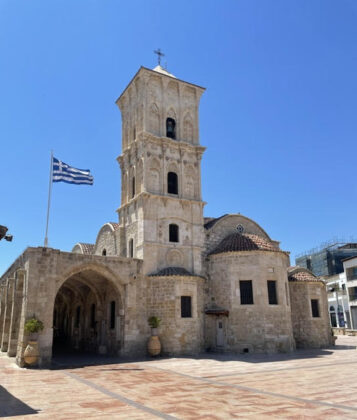
Our first stop was the Church of St. Lazarus in Larnaca. Upon entering, one immediately feels the sanctity of this sacred space. The story goes that after Lazarus was resurrected by Jesus Christ, he became a disciple of Jesus. Later, Lazarus escaped Jerusalem because of anti-Christian persecution and sailed to Cyprus. After spreading the word of Christ, Lazarus died his second death on Cyprus and was buried there. In the 9 th century, Byzantine Emperor Leo VI moved the relics of St. Lazarus to Constantinople, and in recompense, built a beautiful stone church on the burial ground. Under Frankish and Venetian rule in the 13 th through 16 th centuries, a Gothic portico and other elements were added to the church. The Baroque and Rococo carvings and the iconography were installed in the 17 th and 18 th centuries. In 1972, human remains were found under the church. They are considered to be the relics of St. Lazarus that were not removed by Leo VI, and are venerated by the faithful.
After our visit to the church, we wandered along the promenade of Larnaca, a lovely seaside city. Although Aphrodite’s mythological birthplace is Paphos, on the other side of the island, one can imagine her rising out of the sea foam as one sits at a café overlooking the Mediterranean. This same vision, and the beautiful beaches of Cyprus, continue to attract tourists from throughout Europe, North America, and the Middle East.
Eventually, we made our way to the capital Nicosia, which is around 45 minutes away from the Larnaca airport. Nicosia (also known as Lefkosia to the Greeks) was where the conference would take place and where I spent most of my time in Cyprus.
Cyprus has a complicated political history. Over the centuries, the island has been ruled by the Byzantines, the Arabs, the Crusaders, the Venetians, and the Ottomans. From 1878 to 1960, it was a British protectorate. Motor vehicles are still driven on the left-hand side of the road, a remnant of British rule.
In the 1950s, most Greek Cypriots wanted union with Greece, and followed the political movement called Enosis. This did not end up happening, but the Republic of Cyprus was formed in 1960, when Cyprus became independent from Britain. The constitution allowed power-sharing between Greek and Turkish Cypriots.
However, in 1974, Turkey occupied the northern part of Cyprus. Some Greek Cypriots I met refer to this occupation simply as “The War.” My earliest memories related to Cyprus were of the outrage and lobbying among Greek-Americans following the occupation. Unfortunately, the northern part of Cyprus is still occupied, which has left a geographic, psychological, and spiritual wound. Nicosia is the only divided capital in the world. It was partitioned into a Greek side and a Turkish side, just like the rest of the island. Today, tourists may pass through a United Nations checkpoint, but Greek and Turkish Cypriots who once lived together must now live apart.
I stayed in the Old Town of Nicosia. It is full of beautiful historic buildings, some restored, some not. It is the tourist center of Nicosia and many luxury hotels and AirBNBs are located here. Traditionally, many Cypriots would socialize in the Old Town. As I met Greek Cypriots, I learned that many of them no longer frequent the area because of the refugees and immigrants now living there.
Looking at a map, one can see how the location of Cyprus is a crossroads for refugees and immigrants from all over Asia and Africa. The Old Town of Nicosia has many businesses opened by these immigrants. Next to a Greek taverna is an Arab restaurant. Down the street is a Sri Lankan periptero and a Nepalese store. It feels very vibrant, but one can understand how unfamiliar it might be to those Greek Cypriots who grew up in Nicosia.
But it is not just people from Asia and Africa who go to Cyprus. Many Greeks from Greece also live there. Numerous store workers, taxi drivers, hotel employees, and teachers I spoke with came from Greece. When I asked them why they moved to Cyprus, they all said they went for economic opportunities. While Cyprus is a small country (especially as it is divided), they said that the economy is better than in Greece. The teachers said they made three times higher salaries in Cyprus, and all of them said the taxes in Greece are higher.
The influx of Greek workers appears to be welcome. This demonstrates the ongoing strong ties between Greece and Cyprus. A Greek flag flies outside of many churches, sometimes with a flag of Cyprus, sometimes not. The Greek flag above churches in Cyprus reflects the island’s Greek majority, its shared history and culture with Greece, and the constitutional right to display it as part of Cypriot life. The 1960 Constitution of the Republic of Cyprus grants citizens and certain institutions the right to fly the flag of the Republic of Cyprus alongside the Greek flag on holidays and other occasions.
I also viewed contemporary art for an artistic perspective on Cyprus. Nicosia has two wonderful contemporary art museums: the large contemporary SPEL building and a gallery extension housed in a grand old mansion. Some of the art depicts events from the Enosis movement in the 1950s, while other art shows non-political scenes of everyday life.
The Kazantzakis Conference
The Kazantzakis conference organized by the University of Cyprus was an amazing experience. The organizers, Professor Marinos Pourgouris, Professor Afroditi Athanasopoulou, graduate student Tamara Vuković, and their colleagues, brought together scholars and others interested in Kazantzakis from all over the world, including Cyprus, Greece, United States, Canada, United Kingdom, Serbia, Czech Republic, Poland, and Germany. The conference had a focus on Kazantzakis, yet the range of papers was very broad, perhaps because Kazantzakis himself was so prolific and wrote on so many topics.
I was pleasantly surprised by the large number of younger scholars. Although Kazantzakis was nominated for a Nobel Prize many times throughout his life, he had his big moments on the world stage decades ago through the movies “Zorba the Greek” in 1964 and “The Last Temptation of Christ” in 1988. Yet contemporary readers are intrigued by his philosophical explorations and earthy language.
When I first heard about the conference, I wondered about the connection between Kazantzakis and Cyprus. Professor Afroditi Athanasopoulou presented the interesting story of how Kazantzakis visited Cyprus years apart through his wives. In 1926, Nikos Kazantzakis visited Cyprus with his first wife Galatea. At the time, Galatea was a better-known writer than Nikos and she was in Cyprus as a reporter. Although other writers wrote about the miserable conditions in Cyprus in the 1920s, including the poverty of the workers and the heavy British taxes, Kazantzakis did not mention these socio-political issues. After World War II, Nikos went back to Cyprus with his second wife Eleni. He was reporting on the Jewish resettlement in Palestine for Eleftheros Typos. Eleni observed the British refinements in Cyprus (English parks, hotels, etc.) in contrast to Greek poverty. Eleni had more sympathy for the plight of Cyprus than Nikos did, but she eventually influenced him to be sympathetic as well.
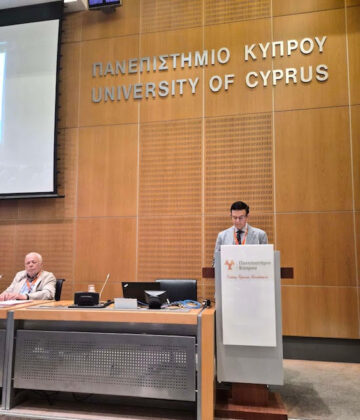
I was honored that my presentation took place on the opening night of the conference after the keynote speech by renowned Kazantzakis scholar Lewis Owens. My paper was entitled “A Comparison of the Apollonian and the Dionysian in the Play Odysseus: A Verse Tragedy and the Novel Zorba the Greek by Nikos Kazantzakis.” Before publishing the play Odysseus, my main exposure to Kazantzakis had been through reading the novel Zorba and seeing the unforgettable movie with Anthony Quinn and Irene Pappas. Working on my paper gave me the opportunity to delve more deeply into these literary works. I found that, while Odysseus displays both rational and irrational sides in Homer’s Odyssey, he is primarily rational and Apollonian in Kazantzakis’s play. In contrast, Zorba is undeniably irrational and Dionysian, though he has his Apollonian moments.
After translator Kostas Myrsiades and I presented our papers about Odysseus, we streamed a staged reading of the play that took place in Foulkeways, Pennsylvania. A video of the reading is on Vimeo and YouTube: https://vimeo.com/1109087267?share=copy#t=0.
The conversation about Odysseus and The Odyssey was especially timely in light of this summer’s blockbuster movie, “The Odyssey.” Professor Marinos Pourgouris presented a paper comparing Homer’s Odyssey and Kazantzakis’s Odyssey: A Modern Sequel. Perhaps most shockingly, Kazantzakis transforms nostos, or the hero’s return home, to an escape from home. Kazantzakis depicts Odysseus’s realization that the stability of Ithaca, after all his adventures, is a form of death, and Odysseus leaves Ithaca forever.
Conclusion
My trip to Cyprus and my participation in the Kazantzakis conference will remain unforgettable to me. I learned more about the complicated history of Cyprus, but also observed the vibrancy of the country. At the conference, I shared in the knowledge about a great Greek author who had his own complications.

Related Posts








0 comments