
- Theo James: The reluctant leading man hho finally steps into the spotlight
- Psaros family invests $25M in the Georgetown Psaros Center for Financial Markets and Policy
- The PanHellenic Scholarship Foundation co-hosted the 5th Annual Oli Mazi Luncheon
- The Kazantzakis Conference in Cyprus
- Remembering Dolly Parton: The Queen of Country Music
From Greek villages to the Diaspora: Preserving memories across generations
Elena Lagoudi from the National Documentation Centre talks to NEO about the digital exhibition bringing Greece’s forgotten stories and traditions back to life
by Kelly Fanarioti
What if, with just the click of a button, you could discover handwritten recipes from the last century originating in your grandparents’ village, read the fairy tales parents once told their children, and learn about the local customs and traditions of the time?
This journey into the past is now possible through “From Village to Village,” a digital exhibition hosted since June on SearchCulture.gr, a free, publicly accessible platform operated by the National Documentation Centre (EKT).
The exhibition brings together approximately 1,200 digitized handwritten folklore records from the “Archive of Manuscripts of Primary Folklore Material” collection at the National and Kapodistrian University of Athens. These records document the traditions and everyday life of more than 1,000 villages and settlements across Greece, Cyprus, Asia Minor, and Pontus.
The pages of these old notebooks bring to life a world that has largely disappeared, filled with traditional recipes, songs, proverbs, local beliefs, forgotten trades, and everyday customs. These accounts were documented by researchers, students, and members of local communities who spoke with village residents to preserve their stories and traditions.
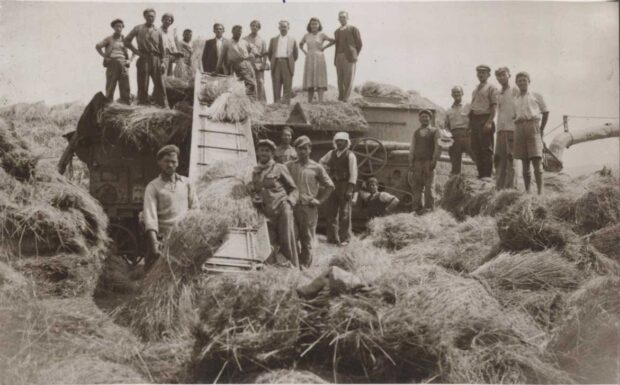
The threshing machinery of the Kozani Union of Cooperatives during an inspection by supervisor Konstantinos Poulios in Xirolimni, Kozani, August 25, 1949 Photo: Varnavas Interactive Agricultural Folklore Museum / SearchCulture.gr
“These handwritten notebooks were put together by amateur ethnographers and students from the University of Athens’ School of Philosophy,” says Elena Lagoudi, a museologist and head of collection curation at SearchCulture.gr, “The students would return to their hometowns and villages, where they used established research methods to document local traditions as they were still being practiced. These accounts were recorded several decades ago, capturing the memories and experiences of a generation that is no longer with us. Some people have even come across their own grandmothers’ recipes or photographs of family members in these collections.”
Many of the manuscripts contain words and expressions in local dialects that only people from those communities might fully understand. According to Lagoudi, this highlights another important aspect of the collection: preserving regional vocabulary, expressions, and storytelling traditions that risk disappearing along with the generations who kept them alive.
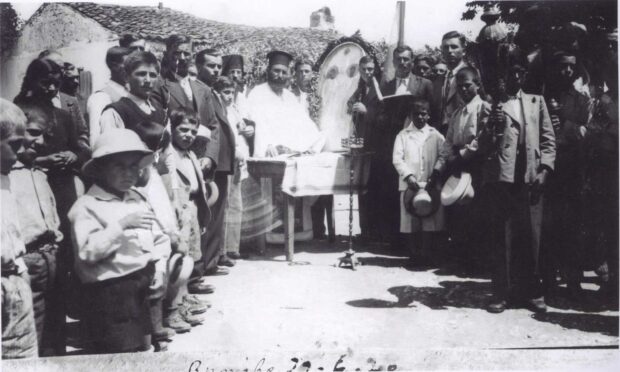
A religious icon procession during the Feast of Saints Peter and Paul in Varnavas, Attica, June 29, 1940Photo: Varnavas Interactive Agricultural Folklore Museum / SearchCulture.gr
During our interview, Lagoudi navigates the platform and selects the village of Skineas on the island of Kefalonia as an example. On the screen, a whole world of folklore comes to life, with records of traditional remedies, fairy tales, proverbs and sayings, riddles, wordplay, blessings, curses, even blasphemies and oaths. There is also a glossary of words and expressions unique to the area, along with accounts of local religious life, beliefs, and superstitions.
“Visitors can see each document exactly as it was originally recorded. It’s like looking through a window into the world as the people who documented it saw it,” she adds.
These handwritten accounts are the result of systematic folklore research initiated and overseen by Georgios K. Spyridakis, then a professor of Folklore Studies, and later by Maria Miligou-Markantoni.
Although most of the records were collected from the 1960s onward, many of the memories, traditions, and everyday practices they document date back to the 19th and early 20th centuries, offering a valuable glimpse into a way of life that has largely disappeared.
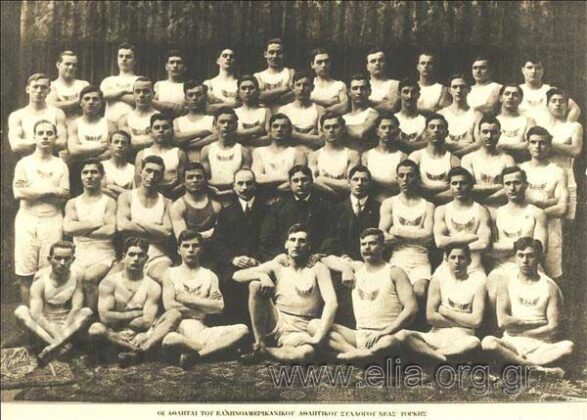
Members of the Greek-American Athletic Union in New York, circa 1905. Photo: ELIA–MIET Photographic Archive / SearchCulture.gr
“From Village to Village,” however, is just one of the many ways to explore SearchCulture.gr. As Margaritis Proedrou, Head of the Publicity and Communications Department at the National Documentation Centre (EKT), told NEO, the digital platform offers visitors a much broader window into Greek history and culture, allowing them to search for historical and cultural materials by person, location, historical period, subject, or type of material.
The thematic exhibitions cover a wide range of subjects, from Orthodox Christianity, which visitors can explore through religious icons, texts, hymns, and objects used in worship, to the everyday lives of the Sarakatsani, the history of the Evzones, and traditional costumes from across Greece. Visitors can, for example, explore the traditional dress of Skyros and discover the distinctive terminology associated with its garments.
“Visitors can also explore the lives and work of people who have left their mark on Greek history and culture through the platform’s biographical profiles. Dedicated sections highlight, among others, women who played a pivotal role in Greek intellectual life, philhellenes, opera performers, and Greek women poets,” says Lagoudi. “They can search by a person’s name or profession, or combine different criteria to narrow their results. For example, they can look for artists born in Asia Minor and then refine their search to specific fields, such as sculptors or icon painters.”
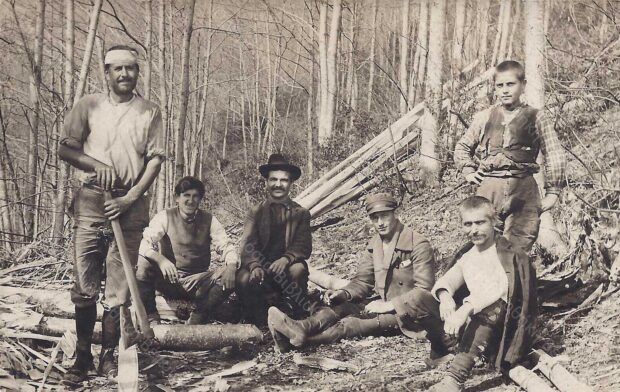
Lumberjacks, somewhere in the kiosk of Kato Seliou, at Mount Vermio Photo: Stergios Apostolou Collection / Veria Public Central Library / SearchCulture.gr
Another important feature is that all thematic exhibitions are also available in English, making their content accessible to those who do not speak Greek. This is particularly valuable for second- and third-generation Greeks living abroad who wish to explore the history and culture of their ancestral homeland.
The National Documentation Centre also plans to use artificial intelligence to help overcome one of the biggest challenges in exploring historical archives: deciphering handwritten documents. Through a project called “Pharos”, the aim is to make manuscripts that are currently difficult to read more accessible to the public. These include letters exchanged between figures of the 1821 Greek War of Independence and personal diaries, whose handwriting and older forms of language can pose challenges for modern readers.
“Handwritten documents present the greatest challenge, and our goal is to make them more accessible to everyone,” Lagoudi explains.
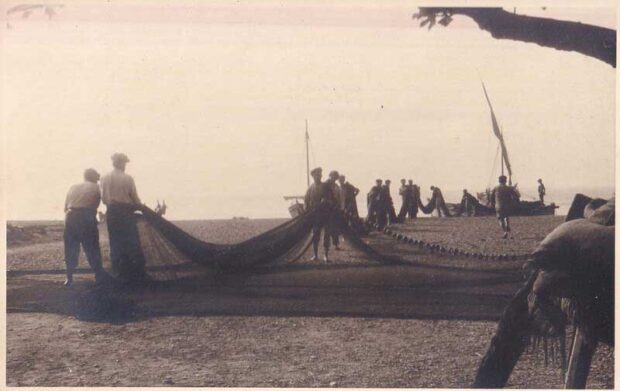
Fishermen with their nets on a beach in Vasiliki, Lefkada, July 28, 1940 Photo: Michalis Tsagaris Collection / Aikaterini Laskaridis Foundation / SearchCulture.gr
Of particular interest to the Greek diaspora are the historical records documenting the experiences of Greek emigrants, which visitors can explore through the broader SearchCulture.gr platform.
Among them are photographs of Greek emigrants departing by ship for Australia, accounts of Greek workers’ lives in German factories, baptisms celebrated abroad, as well as personal letters and diaries.
The collection also includes records offering a glimpse into the history and community life of Greeks in New York. As Lagoudi explains, visitors can discover, among other items, a group portrait of a Greek athletic club in the city, photographs from the March 25 Greek Independence Day celebrations in 1963, and a group photograph dating back to April 1939 of children who belonged to the Olympians of the Hellenic Cathedral club.
Beyond their historical and research value, collections like these offer Greeks living abroad a personal connection to their roots, helping them rediscover family memories, understand the traditions of their ancestors, and preserve a sense of belonging across generations.
“For me, the real value lies in the memory of a community, something you inevitably lose touch with when you emigrate. It becomes something you carry in your mind. I lived in England for 15 years, so I know that feeling of nostalgia very well. I’ve felt that longing for the past. It’s important to preserve local dialects and customs so they can somehow be passed down to future generations,” she explains.
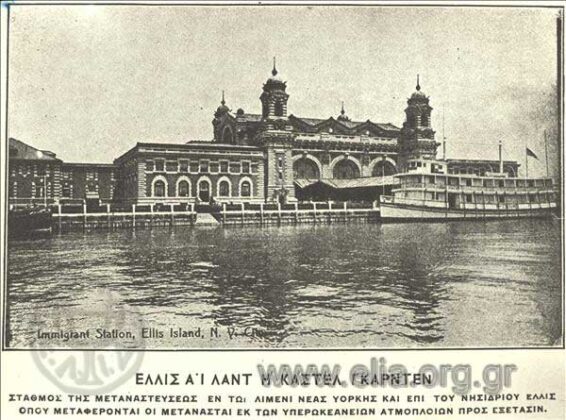
The immigration station at the Port of New York, where passengers arriving on ocean liners were taken for examination
According to Lagoudi, there is growing interest in exploring local history through primary sources, a trend also reflected in the platform’s visitor numbers. Since its launch in June 2026, the digital exhibition “From Village to Village” has received more than 5,000 visits, suggesting that digital access to local history and cultural heritage can offer a new way for people to reconnect with their roots.
“People are yearning to reconnect with their roots, their local heritage, and the memories of generations past. I think there’s a growing sense of urgency among people of our generation. As our parents and other older generations pass away, so much of what we know about the past comes from stories they’ve told us rather than from our own experiences. We could also explore the possibility of offering workshops in English for Greek diaspora schools, giving students a chance to discover the cultural heritage preserved on SearchCulture.gr and learn more about the history and traditions of their ancestral homeland”.
For Greeks living abroad, the exhibition offers something deeply personal: the chance to search for their family’s ancestral village and rediscover, through digitized records, a world that is slowly fading from living memory.
Perhaps this is where the exhibition’s greatest significance for the Greek diaspora lies. The voices, traditions, and everyday moments once captured in the pages of a handwritten notebook can now reach across generations and oceans, bringing descendants closer to the lives their ancestors once knew. What was preserved decades ago in a small Greek village can now find its way to a family thousands of miles away, a reminder that while people may leave their homeland, the stories of where they came from need not be lost.










0 comments