
From Athens to the world: The artist who draws logic
By Kelly Fanarioti
Alecos Papadatos, the illustrator of the internationally acclaimed Logicomix, speaks to NEO about philosophy, storytelling, and the limits of AI
He studied economics, driven by the kind of youthful naïveté that often comes with believing one can change the world. As he grew older, he came to realize that this ambition was in many ways, utopian. Through a series of chance events, he eventually found himself at the Sorbonne, where he pursued a postgraduate degree in the aesthetics of philosophy. At the same time, he trained at an animation production company before returning to Greece.

“I had been drawing since childhood, as had everyone in my family. For many years, I worked in animation alongside my partner and later my wife, Annie Di Donna,” Alecos Papadatos says to NEO.
After some time, he realized that animation had begun to exhaust him and he turned instead to comics, a medium he had loved since he was young. Around that time, he also received a phone call. On the other end of the line was the acclaimed Greek writer and mathematician Apostolos Doxiadis, who invited him to join as an illustrator in what was, for its time, a highly unconventional project.
“Together with Christos Papadimitriou, a professor of computer science at UC Berkeley, they came up with the idea of creating a graphic novel with Bertrand Russell as its central narrator – a figure who devoted much of his life to mathematics and mathematical logic. As a young mathematician, he discovered a paradox at the heart of set theory, now known as ‘Russell’s paradox.’ I was then asked to take on the illustration, and we spent four full years working on the project,” Papadatos says.
He adds, visibly moved, that Russell’s books had been among his father’s favorite readings during the years of the dictatorship. “Although he was an officer in the army, my father held strong democratic beliefs. He was often posted to remote border areas, where he would spend his time reading in secret, mostly philosophy, including Russell. So when Apostolos Doxiadis suggested, years later, that we work on Russell, I was deeply struck by the coincidence.”
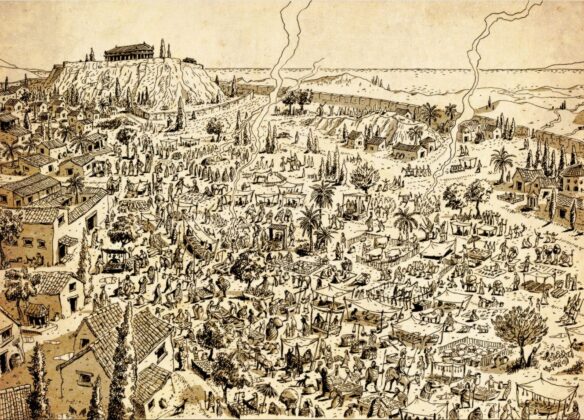
The book Logicomix, which also features prominent 20th-century mathematicians and philosophers such as Georg Cantor, Alfred North Whitehead, Gottlob Frege, Ludwig Wittgenstein, Kurt Gödel and Alan Turing, achieved widespread international recognition. It has been translated into 27 languages and received critical acclaim from major international outlets, including The New York Times, The Guardian, The Times and The Independent. As Alecos Papadatos recounts, however, this success did not come easily, but followed a long series of rejections and uncertainty over how the work should be classified.
“Many publishing houses in both the United States and Europe turned us down. They didn’t know how to classify the book, whether it was fiction, non-fiction, epistemological, or simply entertainment– nor whether it was meant for children or adults. Some found it too abstract, or outside their editorial scope. In the end, it was Bloomsbury-the publisher behind Harry Potter – that took it on.”
What gave them the strength to keep knocking on doors, despite repeated rejections, I ask him. “We had put in an enormous amount of work-in writing, production, and visual development. We knew we had created something exceptionally well-crafted, without flaws. With that confidence, we simply didn’t give up,” he states.
Comics on Aristotle and Democracy
Alecos Papadatos approaches drawing in his own distinctive way. As he explains, he wants to admire his characters, to feel connected to them, and to be challenged by them: one of the reasons he has never been drawn to political cartooning. “It was never my goal to draw Mitsotakis, Tsipras, Khomeini, or Trump,” he says emphatically.
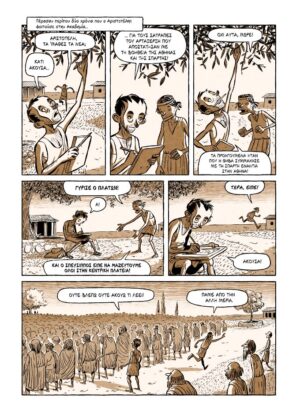
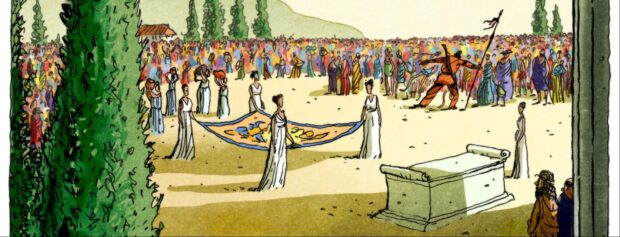
This also explains why, after Bertrand Russell, he turned to the work of the great ancient Greek philosopher Aristotle, as well as to the story of the birth of democracy in ancient Athens. He is currently working on a new project exploring the history of Western philosophy.

“In these graphic novels, the stories convey a certain kind of knowledge to the reader, not necessarily academic, but enough to offer a clear sense of how Western philosophy has evolved. This is a subject that deeply interests me. It involves fascinating characters, with compelling lives, set within uniquely rich contexts.’
‘More broadly, I have a strong interest in philosophy and history; I read extensively and watch related films. Both Logicomix and Democracy are, essentially, historical works. Even Aristotle is about history rather than philosophy; it doesn’t attempt to analyze philosophical ideas, but rather to tell the story of a man who lived in a specific time and articulated certain ideas within that context.”
More broadly, he believes that comics can function as a powerful tool for public understanding. “Many things can be made accessible through comics and animation,” he notes.
At the same time, he draws a clear distinction between what comics are and what they are not.
“Comics are about actions and relationships, not abstract ideas. They show rather than describe. They show people speaking, acting, interacting. Simply taking Einstein’s theory and placing it into speech bubbles is not a comic. What’s missing there is sequentiality, action, and the relationships between characters”.

Artificial Intelligence
At a time when artificial intelligence is rapidly transforming the way images are produced, how secure can an illustrator feel?
He approaches the idea that AI could pose a real threat to illustrators with a degree of skepticism. As he explains, creating a comic is a complex and demanding process, one that in many ways resembles film production.
“First comes the script, then the character design, followed by research: for example, what buildings of a certain period actually looked like. You need to consult encyclopedias, study references—say, the architecture of 18th-century buildings. It’s a lot of work.”
Although there have already been attempts to use artificial intelligence tools to generate images incorporated into comic panels, he believes the results remain limited. As he explains, these systems rely on pre-existing data and, in essence, “produce an average” of images, without being able to replicate the unique visual identity of each artist.
“Today’s AI tools are still very primitive compared to the complexity of human creativity, and they cannot produce work with real artistic or commercial value. There’s no way a machine can create what a human does. I think there’s a lot of unnecessary panic around this.”
However, he acknowledges that artificial intelligence can serve as a useful support tool. For instance, it can significantly speed up the research process, providing structured information and references that would previously have required months of searching.
“You can have a full bibliography in record time, something that would otherwise take months, including trips to libraries abroad to track down specific books,” he notes.
In his free time, Alekos Papadatos plays and sings rebetiko music, a passion he has had since his student years, when he and his friends would perform at gatherings and celebrations, before eventually playing in small Athenian tavernas. For him, rebetiko holds something unique. As he explains, it is the only musical genre in Europe–with the exception of flamenco–where musicians sit around a table, playing bouzouki and guitar, singing along to songs everyone knows, often accompanied by wine. “It’s a communal experience that naturally draws everyone in.”

Related Posts











0 comments