
KEEPING THE FAITH
How early Greek immigrants practiced their religion in America
When the first significant waves of Greek immigrants arrived in the United States between the 1880s and the 1920s, they carried little with them—often a small suitcase, a baptismal cross, and a fierce determination to survive. What they lacked in material wealth, they compensated for with a deep, almost instinctive attachment to Orthodox Christianity, which served as their anchor in a foreign land. For these early arrivals—mostly young men from rural villages—faith was not merely a set of rituals. It was a portable homeland, a way to preserve identity, language, and dignity in a country that often viewed them as outsiders. Before there were churches, priests, or community centers, there was the stubborn insistence that “We must keep our faith alive.” And they practiced their religion in America—creatively, communally, and with remarkable resilience.
Before the churches: Faith in boarding houses, cafés, and tenements
In the 1880s and 1890s, Greek immigrants were scattered across mining towns, textile mills, railroad camps, and urban ethnic enclaves. There were no Greek Orthodox churches yet in most places. So worship began wherever Greeks gathered:
- cramped boarding houses
- coffeehouses (καφενεία)
- rented halls
- back rooms of candy shops or shoeshine parlors
- makeshift shrines in tenement apartments
A typical Sunday gathering might include:
- reading the Orthros prayers from memory
- chanting familiar hymns without a chanter
- lighting candles stuck into saucers of sand
- venerating a small icon brought from the homeland
- reciting the Trisagion for the dead
These improvised services were not full liturgies—there was no priest—but they kept the rhythm of Orthodox life intact.
Icons as portable churches
Many immigrants carried a single icon from their village—often the Panagia, St. George, or their family’s patron saint. These icons became:
- the center of household prayer
- the “altar” for name‑day celebrations
- the object kissed before leaving for dangerous work in mines or railroads
In a world of uncertainty, the icon was a piece of home.
The First Priests: missionaries, wanderers, and community saviors
Priests arrived because communities begged for them.
By the 1890s, Greek communities began writing letters to bishops in Athens and Constantinople:
“Send us a priest. We are like sheep without a shepherd.”
Priests who came to America were often:
- young and adventurous
- widowed (and therefore permitted to serve)
- politically exiled
- or simply willing to endure hardship
They traveled constantly, performing sacraments for scattered Greek laborers across vast distances.
The “Circuit‑Riding” Greek Priest
Before parishes were established, priests functioned like Orthodox cowboys:
- traveling by train or horse
- carrying a portable antimension (the cloth needed for liturgy)
- performing baptisms in rivers or bathtubs
- blessing homes, shops, and even railroad camps
- hearing confessions in kitchens or fields
A priest might serve five or six communities across several states. His arrival was a major event—people took days off work, cooked feasts, and lined up for sacraments.
Sacraments as Community Glue
The sacraments were not just religious rites—they were acts of cultural survival:
- Baptisms ensured children remained Greek Orthodox despite pressure to assimilate.
- Weddings preserved Greek customs and prevented intermarriage in communities anxious about losing identity.
- Funerals offered dignity in a society where immigrant deaths were often ignored or mishandled.
Through these rituals, the priest became the moral and cultural center of the community.
Building the First Greek Orthodox Churches
Before they built restaurants, societies, or even permanent homes, Greek immigrants built churches. The first official Greek Orthodox church in the U.S. was founded in New Orleans in 1864, but the major wave of parish building occurred between 1890 and 1920.
Communities pooled money in remarkable ways:
- miners donated a day’s wages
- café owners held fundraisers
- women baked pastries to sell
- children collected coins
Even the poorest laborers insisted on contributing. The church was not optional—it was essential.
Churches as Multifunctional Community Centers
A Greek church in early America was never just a church. It was:
- a school for Greek language
- a social hall
- a job‑finding network
- a place to store community records
- a meeting place for village compatriots
- a refuge for new arrivals
The parish became the heart of Greek America.
Architecture: A Blend of Old and New
Early churches often looked nothing like Byzantine temples. Many were:
- converted Protestant churches
- rented halls
- simple wooden structures
But inside, Greeks recreated the familiar world:
- icons shipped from Mount Athos
- hand‑painted iconostases
- incense burners from the homeland
- embroidered altar cloths made by immigrant women
Over time, as communities prospered, they built more traditional domed churches.
Worship in a New Land: Services Were Entirely in Greek
For the first generations, the liturgy remained 100% Greek. This was not only a religious choice but a cultural one:
- Greek was the language of identity
- English was associated with assimilation
- parents feared losing their children to American culture
Even when children understood little, they absorbed the rhythms of Orthodoxy through sound and repetition.
Chanting Without Trained Cantors
Most communities lacked trained chanters (ψάλτες). Instead:
- older men who remembered hymns from the village stepped forward
- chanting was often off‑key but heartfelt
- Byzantine melodies mixed with local folk styles
This created a uniquely Greek‑American chant tradition, raw but deeply sincere.
Holy Week as the Emotional Center of the Year
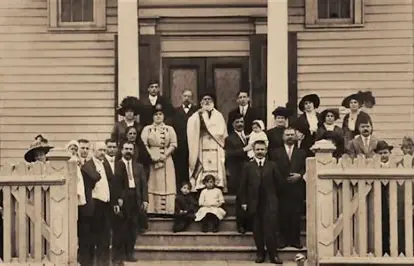
Holy Week was the most important religious event for early immigrants. Even those who worked seven days a week tried to attend:
- the mournful hymns of Holy Thursday
- the procession of the Epitaphios through immigrant neighborhoods
- the midnight cry of “Χριστός Ανέστη!”
For many, these moments were the only times they felt truly at home in America.
Home Rituals: The Icon Corner (το εικονοστάσι)
Every Greek home, no matter how small, had an icon corner:
- a few icons
- a vigil lamp
- a small cross
- holy water from the last Theophany
- a sprig of basil from the previous year’s feast
This corner was the spiritual heart of the household.
Fasting as a Marker of Identity
Immigrants kept the traditional fasts:
- Great Lent
- Wednesdays and Fridays
- the Dormition Fast
- the Nativity Fast
Fasting was a way to maintain discipline and continuity. Even those who worked brutal industrial jobs tried to keep at least part of the fast.
Name Days Over Birthdays
Birthdays were not widely celebrated in early Greek America. Instead, name days were the major personal feast:
- friends visited without invitation
- coffee and sweets were served
- the house filled with greetings of “Χρόνια Πολλά!”
This tradition reinforced the connection between personal identity and the saints.
Death, Mourning, and Memory: Funerals as Acts of Communal Solidarity
When a Greek immigrant died—often young, often far from family—the community stepped in:
- raising money for burial
- organizing the funeral
- ensuring Orthodox rites were followed
No one was allowed to be buried without dignity.
Memorial Services (Μνημόσυνα)
Memorials were essential for maintaining bonds with the dead. Women baked κόλλυβα, and the community gathered to chant:
- “Αιωνία η μνήμη”
- “Memory eternal”
These rituals softened the loneliness of exile.
Faith and Ethnic Identity: Orthodoxy as the Guardian of “Greekness”
For early immigrants, Orthodoxy was not just a religion—it was the last line of defense against losing their Greek identity. The church preserved:
- language
- customs
- food traditions
- village networks
- moral codes
To be Greek was to be Orthodox; the two were inseparable.
The Church as Mediator with American Society
Priests often acted as:
- translators
- legal advisors
- mediators with employers
- advocates in court
- protectors against discrimination
The church helped Greeks navigate a society that often viewed them as “undesirable” immigrants.
The Rise of Greek Schools and Youth Organizations
By the 1910s, many parishes established Greek afternoon schools:
- children attended after public school
- they learned reading, writing, and church hymns
- teachers were often recent immigrants or priests
These schools were crucial for maintaining Greek literacy.
Sunday Schools in English
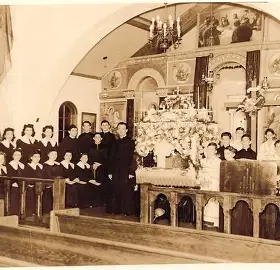
As American‑born children grew, parishes introduced Sunday schools in English to teach:
- basic Orthodox theology
- Bible stories
- moral lessons
This was the first major adaptation to American life.
The First Greek Festivals
Early Greek festivals were modest:
- a small procession
- homemade food
- music from a violin or clarinet
But they served as public declarations of identity.
Epiphany Blessing of the Waters
In cities near water—Tarpon Springs, Chicago, New York—Greeks introduced the dramatic Blessing of the Waters:
- priests threw the cross into rivers or harbors
- young men dove in to retrieve it
- crowds gathered to watch this exotic ritual
These events helped Greeks claim public space in America.
The Transition to a Greek‑American Orthodoxy
By the 1920s and 1930s, the children of immigrants were growing up American. This forced the church to adapt:
- sermons began to include English
- choirs replaced traditional chanters
- parishes adopted American organizational models
- youth groups formed
- intermarriage increased
Orthodoxy remained the anchor, but it slowly became Greek‑American rather than purely Greek.
So the story of early Greek immigrants in America is, in many ways, the story of how a people used faith to survive displacement. Orthodoxy gave them:
- structure
- dignity
- continuity
- community
- a sense of home
From makeshift altars in boarding houses to the grand domed cathedrals of today, the Greek Orthodox Church in America stands as a monument to the resilience of those first immigrants who refused to let their faith fade in the New World.
Their story is not only religious—it is profoundly human. It is the story of people who, despite hardship and prejudice, built a spiritual homeland that allowed future generations to thrive.
The First Greek Orthodox Parishes in America
These are the foundation communities from which Greek Orthodoxy spread:
| Year | Parish | City & State | Notes |
| 1864 | Holy Trinity | New Orleans, LA | First officially organized Greek Orthodox parish in the U.S. |
| 1885–1890 | Small lay communities | New York, NY | Worship in rented halls before formal parish formation. |
| 1892 | Evangelismos (Annunciation) | New York, NY | First major parish in the Northeast. |
| 1895 | Holy Trinity | Chicago, IL | First parish in the Midwest; major immigrant hub. |
| 1898 | Holy Trinity | Lowell, MA | One of the earliest New England parishes, tied to mill workers. |
| 1900 | Holy Trinity | San Francisco, CA | First parish on the West Coast. |
| 1905 | St. George | Manchester, NH | Early industrial‑town parish. |
| 1906 | St. Sophia | Washington, DC | Early capital‑region parish. |
The History of One Representative Parish
The Assumption Greek Orthodox Church (Chicago, Illinois) (Panagia – Dormition of the Theotokos)
The Assumption parish began in 1925, founded to serve the growing Greek immigrant population in Chicago’s Austin neighborhood and the nearby western suburbs of Oak Park and Cicero. Early Greek families in this area—many working in small businesses, railroads, and trades—needed a spiritual home close to where they lived.
The Greek population of Chicago’s Austin, Oak Park, and Cicero districts was still small but tightly knit. These were not wealthy merchants like those who founded Holy Trinity downtown in 1895. They were working‑class families, many from the Peloponnese, Epirus, and the Aegean islands.
These families typically included:
- Railroad workers (Chicago & Northwestern, Illinois Central)
- Café and candy‑store owners
- Cigar makers and shoemakers
- Small grocers and fruit peddlers
- Women working as seamstresses or in family shops
They pooled money to rent a hall, then to build the first wooden church.
The “First Circle” likely included families with surnames such as:
- Pappas / Papadopoulos
- Kostas / Costas
- Kouvelis / Kouvelas
- Karras / Karas
- Gianopoulos / Giannopoulos
- Vlahos / Vlahakis
- Economou / Oikonomos
- Kanelos / Kanellos
- Stathopoulos / Stathos
- Manolis / Manolopoulos
These names appear repeatedly in 1920s West Side Greek directories, early parish bulletins, and local Greek‑language newspapers.
When the community decided to replace the wooden structure with a permanent stone church, it required enormous sacrifice. The Great Depression had hit Chicago hard, yet the parishioners insisted on building something worthy of the Panagia.
These families were known for:
- donating a week’s wages
- mortgaging their homes
- hosting fundraisers in their shops
- volunteering as masons, carpenters, and painters
Prominent surnames associated with the building campaign:
- Camburas — the architect P.E. Camburas was central to the project.
- Koulogeorge — early benefactors and community organizers.
- Lianos / Lianides — involved in fundraising committees.
- Katsaros — known for supporting iconography and interior decoration.
- Kokinis / Kokkinos — active in the parish council.
- Demos / Demopoulos — donors to the altar and sanctuary furnishings.
These families appear in 1930s parish minutes, Greek-American newspapers, and Chicago Tribune society notes describing the church’s consecration.
Greek immigrant women were the backbone of Assumption’s early life. They organized the Philoptochos Society, cooked for fundraisers, taught children Greek, and kept the parish solvent during the Depression.
Typical women’s surnames in early records:
- Mrs. Kanelos — led early charity drives.
- Mrs. Gianakopoulos — organized Greek school events.
- Mrs. Vlahos — known for embroidery of altar cloths.
- Mrs. Karahalios — coordinated Holy Week preparations.
- Mrs. Manolis — ran the parish’s first youth choir.
These women preserved traditions like:
- making prosphora
- preparing kollyva
- decorating the Epitaphios
- teaching children hymns and prayers
Their work kept the parish culturally Greek even as the children became American-born.
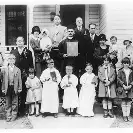
These were the children who:
- attended the first Greek school
- served as altar boys
- joined the first choir
- marched in the first Greek Independence Day parades
Common second‑generation surnames in school rosters and youth groups include:
- Pappas
- Karras
- Stathos
- Economou
- Kanelos
- Demos
They became the bridge between immigrant Orthodoxy and American life.
When it came time to build a permanent church, even during the Depression, the community insisted on:
- real stone
- hand‑painted icons
- a proper dome
- imported ecclesiastical items
Beauty was a form of dignity.
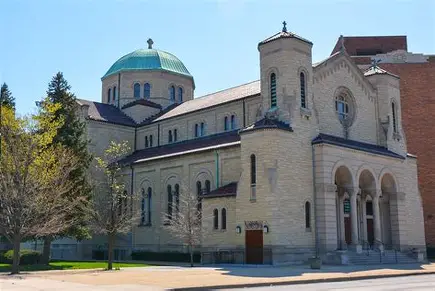
The first church was a small wooden structure, modest but deeply meaningful to the community. As the community grew, the parish replaced the original wooden building with a new stone church, completed in 1938.
- Designed by P.E. Camburas, a prominent Greek‑American architect.
- Built in the Byzantine cross‑in‑square style, crowned with a dome.
- Exterior constructed of Wisconsin Lannon stone, giving it a monumental presence.
This building became one of the most recognizable Orthodox churches on Chicago’s West Side.
After World War II, the parish commissioned the renowned ecclesiastical artist John A. Mallin to decorate the interior.
- Mallin received major commissions in 1946 and 1948, indicating a significant investment by the parish.
- The church was consecrated in 1947, marking its full liturgical completion.
- By the late 1940s, the parish had grown to over 5,000 families, making it one of the largest Greek Orthodox communities in the Midwest.
Newspaper accounts from the era describe the church’s Easter services as filled with “brilliance of gold and blue”, with elaborate icons, candelabra, and chalices.
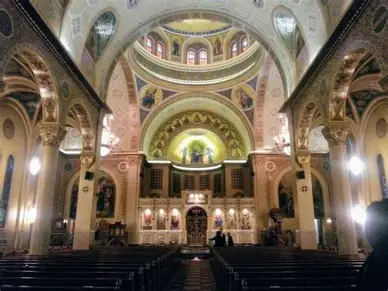
Architectural highlights include:
Narthex
- Wall paintings of Christ with the children and St. Paul at the Areopagus.
Nave
- A dome featuring a Renaissance‑style depiction of God, surrounded by prophets and evangelists.
- A blend of Byzantine and Western artistic influences—unusual but characteristic of Greek‑American churches of the mid‑20th century.
Sanctuary
- The Platytera (“Wider than the Heavens”) icon of the Virgin Mary above the altar.
- A detailed iconostasis (some icons later replaced).
Most of Mallin’s original work remains intact today.
In October 2025, the parish celebrated its 100th anniversary, a major milestone for Chicago’s Greek community.
Highlights of the Centennial Weekend
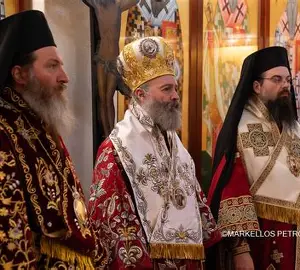
- Archbishop Elpidophoros of America presided over the Divine Liturgy.
- Metropolitan Nathanael of Chicago and other clergy concelebrated.
- The parish honored the “heroes of the community”—the early immigrants whose sacrifices built the church.
- A Centennial Gala was held at the Westin O’Hare with hundreds in attendance.
- The parish announced support for the Ecumenical Patriarch Bartholomew Foundation.
The celebration emphasized continuity with the faith and traditions of the early Greek immigrants who founded the parish.
Today the Assumption remains a vibrant parish, known for:
- Its Byzantine‑Romanesque architecture
- Its historic iconography
- Its active ministries and community outreach
- Its role as a spiritual home for generations of Greek‑Americans in Chicago
The church’s copper‑patina dome, visible from the Eisenhower Expressway, continues to be a landmark for the city’s Orthodox faithful.







0 comments