
IN SERVICE OF THE STATES: GREEKS AT THE BATTLE OF DERNA
by Dean Kalimniou*
The painting Attack on Derna by Charles Waterhouse, is unremarkable, with the eye drawn to the advancing American force, to the Marines pressing forward under command, to the flag that will soon be raised and fixed in the historical imagination. Yet to the right of that movement, slightly removed from its compositional centre, there appears a figure clad in the foustanella, advancing within the same field of fire. His presence is neither explained nor incidental. It invites a question. Who was he, and how did he come to be there?
There are episodes in the long and fractured history of Hellenism that appear only as marginal annotations in the archives of others, acknowledged in passing, seldom examined. One such episode is the participation of Greek fighters in the Battle of Derna, an engagement that occupies a modest place in American military memory and an even smaller one in Greek historical consciousness. Yet within that encounter, fought on the littoral edge of North Africa in 1805, there exists a fragment of Greek experience that speaks to a wider condition: displacement, endurance, and the persistent translation of martial skill into foreign causes.
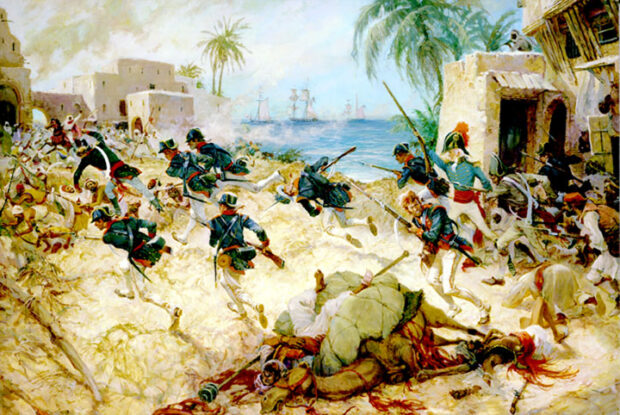
Attack on Derna, by Charles Waterhouse
The expedition itself, led by William Eaton and accompanied by a small detachment of United States Marines under Presley O’Bannon, has often been framed as an early expression of American expeditionary warfare. Such a framing obscures the composition of the force that made the campaign possible. Eaton’s army was an assemblage. Arabs, Berbers, Turks, Europeans, and, crucially, Greeks were drawn together under conditions of necessity, promise, and coercion. Among them, approximately forty Greek mercenaries, led by Captain Luco Ulovix and a lieutenant known only as Constantine, formed a disciplined contingent that would come to bear a disproportionate share of the fighting.
The expedition formed part of the wider conflict between the United States and the Barbary regencies of North Africa, in which tribute, piracy, and sovereignty intersected in unstable fashion. Tripoli, under the rule of Yusuf Karamanli, declared war on the United States in 1801 following disputes over payments and recognition. Eaton’s mission emerged from an alternative strategy. Rather than relying solely on naval pressure, he sought to intervene in Tripoli’s internal politics by restoring the exiled claimant Hamet Karamanli to power. The march on Derna took shape as a landward thrust designed to destabilise the regime from within, combining military force with dynastic substitution. In this, the campaign assumed a significance beyond its immediate objective. It marked the first instance in which the United States projected force inland on foreign soil, confronting both geography and political fragmentation in equal measure.
The archive preserves them imperfectly. Luco Ulovix appears under shifting orthographies, his name refracted through foreign ears. Constantine is rendered without surname, as though individuality itself had been pared away in translation. Around them stand the unnamed, their identities dissolved into number. This partial visibility is instructive. It reveals how easily Greek actors, when operating beyond the framework of an emerging national narrative, pass into abstraction.
Their presence requires explanation. These were men of the Ottoman world, drawn from Greek-speaking communities extending across the Eastern Mediterranean. Many would have belonged, directly or by inheritance, to the klephtic milieu of the late eighteenth century, a world in which mountain warfare, ambush, and negotiated authority constituted both livelihood and resistance. Survival depended upon mobility, improvisation, and endurance. These were precisely the qualities demanded by Eaton’s expedition. Others may have emerged from maritime or mercantile environments where arms and trade intersected. What united them was neither ideology nor programme, but readiness. In a landscape marked by imperial constraint and local instability, martial capacity became a transferable resource.
It is also necessary to consider the figure through whom many of these men were drawn into the enterprise. Hamet Karamanli, the exiled claimant whose restoration Eaton sought to effect, was widely understood to be of partial Greek descent. In the fluid social world of the Ottoman Mediterranean, such affinities retained meaning. They facilitated trust, opened channels of recruitment, and rendered service under his banner intelligible to Greek fighters accustomed to navigating overlapping identities. His presence supplied a political objective for the expedition and a point of cultural orientation through which Greek mercenaries could be gathered and organised.
Eaton encountered these men in Egypt, in the cosmopolitan environment of Alexandria, where displaced populations and opportunists converged. Recruitment proceeded along pragmatic lines. Karamanli’s reputed lineage, circulating within Levantine networks, functioned as an inducement, lending the enterprise a familiarity that eased enlistment among men otherwise wary of purely foreign command. For the Greeks, such inducements aligned with an existing pattern of service under foreign banners. Venetian, Russian, and Ottoman forces had all, at various times, incorporated Greek fighters. The transition into an American-led expedition represented continuity rather than departure.
From the outset, the Greeks distinguished themselves as the most reliable element within a force marked by instability. Cultural and religious divisions were pronounced, and Arab auxiliaries mutinied repeatedly over pay and provisions. The march across the Libyan desert, extending over five hundred miles, imposed its own test. Water failed. Animals collapsed. Provisions were reduced to rationed handfuls. Under such conditions, parts of the expedition faltered. The Greek contingent did not. They remained intact and, at critical moments, assisted in restoring order when the expedition threatened to fragment.
This reliability reflected an internal structure forged under pressure. Greek communities within the Ottoman Empire had long cultivated forms of cohesion grounded in language, religion, and local leadership. Within Eaton’s expedition, these translated into military effectiveness. The Greeks operated as a company, under recognised officers, with a clear chain of command. When disorder emerged, their readiness to enforce discipline transformed authority into something tangible.
By the time the expedition reached Derna in April 1805, it had been reduced, strained, and tested. The final assault on the city’s defences would determine the outcome of the campaign. Eaton divided his forces. The attack on the harbour battery, a fortified position commanding the town, was entrusted to a composite unit under O’Bannon: six Marines, approximately twenty-four artillerymen, and around twenty-six Greeks, including their officers.
The Greeks formed nearly half of the assaulting force. Their role was central. As the attack commenced on 27 April, naval bombardment provided cover. The assaulting column advanced across exposed ground, broken by rock and scrub, offering little concealment. Fire from the defenders was direct and sustained. The Greeks advanced within this exposure, returning fire, closing distance, and maintaining formation under conditions that favoured disorder. Their movement retained cohesion, sustained by discipline rather than impulse.
At this point, their contribution becomes unmistakable. They engaged enemy riflemen, pressed towards the battery, and formed a substantial portion of the force that overran the position. Casualties among them were significant. Eaton’s report records that of the fourteen killed or wounded in the assault, the majority were Greeks.
The capture of the battery proved decisive. With its guns silenced, the defensive capacity of Derna collapsed. The American flag was raised, an image that would later acquire symbolic resonance within U.S. military tradition. Beneath that symbol lay the reality of a composite force in which Greek fighters had borne a substantial share of the burden. Eaton acknowledged this directly, stating that the city could not have been taken or held without them.
The relative obscurity of their contribution lies in the structure of historical narrative itself. National histories consolidate coherence by privileging their own actors and symbols, while the presence of foreign auxiliaries introduces elements that resist easy incorporation. Within Greek historiography, Derna occupies an uncertain position. It precedes the War of Independence and sits outside its ideological frame, an episode in which Greek fighters appear without an explicitly Greek cause.
Yet the significance of their participation becomes clearer when placed within a broader continuum. These men emerged from a milieu in which armed experience was already deeply embedded, shaped by klephtic practice and sustained by long familiarity with irregular warfare. At the decisive moment of the Derna assault, the Greek contingent advanced under concentrated fire, maintained cohesion, and forced the collapse of the defensive position. Their casualties correspond to that role with unmistakable clarity.
Such conduct does not belong solely to the circumstances of this engagement. It reflects a capacity that would soon find a different object. Within two decades, similar men, formed within the same conditions and carrying the same discipline, would act in a struggle directed towards liberation. What appears here as service within a foreign expedition may therefore be read as an early expression of a disposition that had not yet found its proper political form.
After Derna, the Greeks dispersed once more into the Mediterranean world. There was no formal recognition, no enduring incorporation into the narrative that followed and they passed from the record as they entered it, briefly visible, then absorbed into obscurity. Their disappearance reflects a broader pattern in which transnational actors resist incorporation into narratives structured by the later logic of the nation-state. Within such frameworks, mobility, service, and contingency remain difficult to accommodate, yielding instead to accounts organised around coherence and continuity. Yet within these marginal presences, an alternative historical texture becomes discernible, one in which endurance precedes recognition and participation exceeds the categories through which it is later interpreted. The Greeks at Derna occupy precisely this space, situated at the intersection between action and its subsequent erasure.
The archive records the raising of a flag. It also preserves, in less conspicuous form, the presence of those who made that moment possible. In the conduct of the Greek contingent one may discern, rather than an anomaly, but an early indication of a people already prepared, when the moment came, to direct that same force towards their own freedom.

Related Posts












0 comments