
- VICTORIA KYRIAKIDES: AT THE VANGUARD OF FASHION, IN GREECE AND THROUGHOUT THE WORLD
- Greek-American Cassandra Kulukundis on her 2026 Oscar win for ‘Best Casting’
- IN SERVICE OF THE STATES: GREEKS AT THE BATTLE OF DERNA
- Ancient Greek Theatre (AGT) students of Hellenic Classical Charter Schools in Brooklyn (Park Slope) and Staten Island in Greece!
- From Athens to the world: The artist who draws logic
CLOSING THE ACADEMY: THE REAL STORY
by Dean Kalimniou*
The assertion that Justinian closed the Academy of Athens in 529 has entered historical discourse as a proposition that appears self-evident precisely because it is seldom tested, functioning as a compressed narrative in which legal regulation, local circumstance, and philosophical succession are gathered into a single image of termination that acquires authority through repetition rather than documentation. The surviving evidence, when restored to its proper scale, describes neither an act of closure nor the extinction of philosophical instruction at Athens, but a reconfiguration of the conditions under which teaching could be conducted with support from a public purse already allocating resources according to shifting priorities and guiding ideologies.
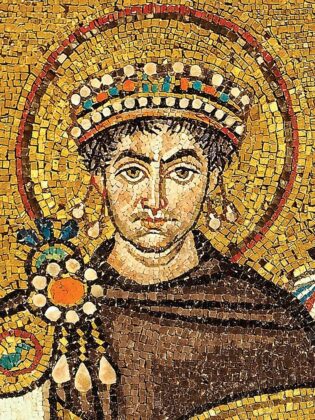
By the early sixth century, philosophical instruction in Athens existed within the structures of late Roman civic administration and imperial patronage, and although the teaching circle active there identified itself with the Platonic tradition, its organisation bore little resemblance to the Academy of classical antiquity, since authority rested upon paedagogical lineage, reputation, and civic endorsement rather than statutory continuity. Leadership was vested in Damascius, whose position as head of the school is recorded by the historian Agathias, while the composition of the circle reveals the geographical orientation of late antique philosophy, as its leading members originated from Syria, Cilicia, Phrygia, Lydia, Phoenicia, and Gaza, confirming that Hellenic philosophical culture had long since shifted eastward and that Athens functioned as one centre among many within a dispersed intellectual network rather than as a singular or dominant locus of philosophical life.
Any assumption of uninterrupted institutional continuity is further weakened by the earlier history of the site itself. During the siege of Athens by Sulla in 86 BC, the Academy was physically devastated, its groves laid waste along with the Lyceum, an episode recorded unambiguously by ancient sources. Philosophical teaching resumed in Athens thereafter without reconstituting the Academy as a physical institution, and when Antiochus of Ascalon returned to the city in the decades following, instruction took place in gymnasia rather than at the Academy proper, which Cicero later describes as deserted. The “Academy” of late antiquity thus denoted an intellectual lineage rather than a restored institution, a distinction essential to understanding later claims of closure.
The Neoplatonic school at Athens represented a revival rather than a survival. Organised instruction re-emerged in the early fifth century under figures such as Plutarch of Athens and Syrianus, establishing a teaching circle whose authority rested upon philosophical succession rather than institutional inheritance. By the time Damascius assumed leadership in the early sixth century, the school’s orientation had shifted further, steering away from theurgic practice and ritual emphasis toward intensified philosophical study grounded in Aristotle, Plato, Orphic theogony, and the Chaldean Oracles. This reorientation reflects an attempt to preserve philosophical legitimacy under increasing external scrutiny rather than a simple insistence upon cultic observance.
Educational activity in late antiquity depended upon mixed economies of support, with publicly recognised teachers occupying endowed chairs sustained by civic or imperial funding, so that prestige, authority, and livelihood were intertwined with a city’s capacity to maintain those arrangements and confer endorsement. Eligibility for such posts became increasingly dependent upon religious affiliation, and Justinian’s legislative programme, articulated most clearly in the Codex Justinianus, extended earlier Christian imperial policy by tying public teaching roles to orthodox confession and withdrawing state support from teachers who did not conform to the established faith. These measures regulated access to public office, public money, and civic authority, reshaping the practical conditions under which a teacher could appear as a civic functionary rather than as a private intellectual.
The manner in which this legislation operated is clarified by its silence. Neither the Codex Justinianus nor the later Novellae name Athens, philosophy, or any institution identifiable as an Academy, despite the remarkable specificity with which Justinianic law regulates professions, offices, salaries, and jurisdictions elsewhere, indicating that the measures were conceived as general regulations governing eligibility for publicly supported roles rather than as targeted interventions. When this framework was applied at Athens in 529, its effects were nonetheless immediate, since philosophical instruction there depended upon civic endorsement and imperial provision, so that loss of eligibility entailed loss of position, withdrawal of support, and with it the disappearance of a public voice. No decree survives ordering the closure of a philosophical institution, and no contemporary source records buildings being sealed or teaching being prohibited, because the intervention operated through administrative exclusion rather than physical elimination.
Later narrative sources preserve a specific local context for the application of this policy, indicating that professors associated with the Athenian philosophical circle required Christian students to participate in pagan rites connected with graduation or ceremonial observance, placing philosophical instruction in direct conflict with the religious identity of the civic environment and transforming pedagogy into a contest over public allegiance. The imperial response consisted in withdrawing public support from the teachers involved, addressing the conditions under which teaching could be publicly recognised rather than the substance of philosophical inquiry itself.
The selective character of this outcome becomes clearer when contrasted with the continued public support afforded to grammarians and rhetoricians, whose disciplines remained integral to imperial administration, legal practice, and ecclesiastical formation. Instruction in rhetoric and grammar aligned readily with the needs of governance, supplying linguistic, forensic, and exegetical skills applicable to courts, chancelleries, and episcopal schools, while philosophy occupied a less immediately utilitarian position within the late antique curriculum, its marginalisation reflecting a recalibration of educational priorities rather than a repudiation of classical learning as such.
The scope of the intervention remained limited. Other centres of philosophical activity continued without interruption, and Alexandria, as well as Antioch, retained their intellectual institutions throughout and beyond Justinian’s reign, confirming that the measures formed part of a pattern of governance responsive to local conditions and conflicts rather than a universal campaign against pagan education or philosophical learning.
Urban conditions at Athens further shaped these developments. By the sixth century, the city had experienced prolonged demographic contraction, diminished municipal revenues, and a reduced political profile within the eastern empire, weakening civic capacity to sustain advanced instruction even before imperial support was withdrawn. The loss of funding therefore accelerated a process already shaped by local economic constraint, at a moment when symbolic prestige could no longer compensate for material limitation.

Following the withdrawal of support and the inability to secure alternative patronage within the city, a group of philosophers associated with the Academy departed Athens. Agathias provides the most detailed account of this movement, identifying seven philosophers, Damascius of Damascus, Simplicius of Cilicia, Priscian of Lydia, Eulamius of Phrygia, Hermias of Phoenicia, Diogenes of Phoenicia, and Isidore of Gaza, and recording their journey to the court of the Persian king Khosrow I in Ctesiphon in search of support. Their departure reflects the conditions under which elite intellectuals operated in late antiquity, where legal standing, security, and patronage determined the viability of teaching and writing.
The philosophers’ stay in Persia proved brief. Agathias reports dissatisfaction with the conditions encountered there and a petition for return to Roman territory, coinciding with diplomatic negotiations between the Roman and Persian empires and culminating in a peace settlement concluded in 532. A clause was included in the treaty providing that the philosophers should be permitted to return and live in safety without compulsion to abandon their traditional religious practices, inclusion of which the Persian king made a condition of the agreement, elevating the fate of a small philosophical circle into a matter of imperial diplomacy.
Upon their return, the philosophers were received under Justinian’s authority without record of punishment, imprisonment, or forced conversion, yet public support for their teaching positions was not restored. Philosophical instruction at Athens therefore lacked the legal and material conditions required for public operation, and the Neoplatonic circle ceased to function as a civic institution. Instruction persisted through private teaching, writing, and transmission beyond the framework of municipal recognition, at a moment when demand for this form of paedagogical authority had itself diminished as intellectual energies increasingly gravitated toward theological, rhetorical, and administrative disciplines aligned with the priorities of a Christian imperial society.
Contemporary responses to the events of 529 reinforce this assessment. Apart from a notice preserved in the Chronicle of John Malalas, late antique sources do not record a dramatic termination of philosophical instruction at Athens, and the absence of extensive commentary or lamentation suggests that these developments were understood as part of ordinary administrative regulation rather than as an exceptional cultural rupture.
Philosophical activity in the sixth century continued in other centres and in other forms. Figures such as Simplicius produced extensive commentaries during this period that preserved and systematised earlier philosophical material, circulated widely, and exerted influence across cultural and confessional boundaries, while philosophical concepts, logical techniques, and ethical frameworks persisted within Byzantine education through florilegia, manuals, and exegetical traditions embedded within theological and rhetorical contexts that ensured their continued circulation.
As public support receded and civic interest cooled, philosophical teaching at Athens drifted beyond the perimeter of recognised public concern and survived, where it survived at all, through private effort and inherited loyalty rather than institutional commitment. Later generations preferred to remember this as an ending, though contemporaries experienced it as a series of reasonable adjustments, each defensible in isolation and none requiring announcement. Positions were allowed to lapse, priorities recalibrated, and assurances offered that nothing essential was at stake, until absence itself acquired the appearance of inevitability. Those observing the present attenuation of government support for Modern Greek language programmes in Victoria, accompanied by familiar expressions of regret and confidence in resilience, may recognise the administrative temperament at work and discover that the fate of Damascius and his circle no longer belongs entirely to late antiquity, having acquired the uncomfortable clarity of lived experience, out with a whimper rather than a bang, and without a whiff of martyrdom.











0 comments