
- Leading HANAC: Stacy Bliagos on Community Service in New York
- The Hellenic Initiative Celebrates Record-Breaking Weekend in New York
- Building the Future: HANAC’s 53rd Anniversary Gala Honors Advocates for Affordable Housing and Community Care
- Leona Lewis: Las Vegas residency ‘A Starry Night’
- Emmanuel Velivasakis, Distinguished Engineer and Author, Presents His Book at the Hellenic Cultural Center
The Quay
by James Terezakis
A lazy morning sun cast its shadow on “Quay Street.“ The 4-Kilometer boulevard that was adjacent to the waterfront at “Smyrna.”
Smyrna, the jewel of ancient Anatolia — a polyglot population of 300,000, divided by Greeks,Turks, Armenians & Levantines.
In 1919, a fabulously wealthy city —- the “Dubai” of the East. There were European-designed hotels, restaurants, cafes, boutiques, complimented by concert halls & theaters, with 22 daily newspapers.
Today, May 15 1919, would be a historic day. “Mother Ellas,” with the blessing of the Great European Powers, would be sending 15,000 troops to “Smyrna” under the “Treaty of Sevres.”
They had negotiated a protectorate over the territory of Smyrna. The Greeks would monitor the city. The orchestras and local bands played the “Hymn to Liberty.”
The Greek citizens of Smyrna cried as soldiers disembark assembled. Across the crowd, people stood in awe. There has not been a Greek military presence in Anatolia for 500 years, since the Fall of Constantinople, on May 29, 1453.
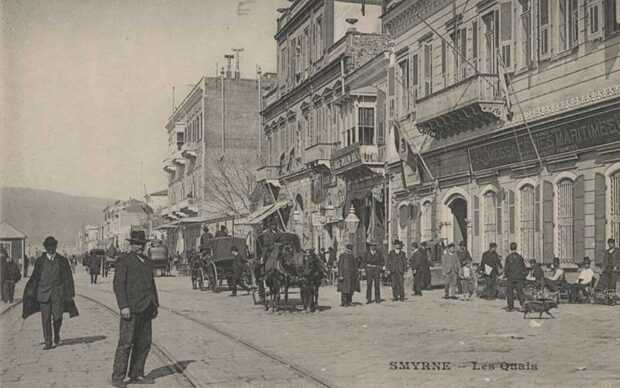
Leading the parade were the “Evzones.” The traditional Palace Guards in their white foustanellas and blue and white vests sporting their knives with the ancient swords. Following them the 8th Cretan Regiment accompanied with their Lyra—wearing black kerchiefs and white boots. They drew the most applause. Many people felt that Constantine Palaiologos XI was the last Emperor of Byzantium. The present King Constantine would re-establish—through the “Megali Idea” —-the new “Byzantine Empire.”
“Kafenion O Ermis,” or Café Hermes, along with Café Apollon, were the most frequented, visited and talked about cafes on the Quay. The “Café Hermes” catered to merchants, bankers, and Smyrna’s cultural elite.They came for the best Turkish coffee, “kahvesi,” with sweets like “lokum” and baklava.
With all the noise and festivity, the great merchant found a table. From Alexandria, Egypt, came Manolis Benakis, the great cotton producer and exporter. Sitting next to him was Vaglianos, a third-generation shipping tycoon, originally from Kefalonia. His grandfather led the movement to replace sailing boats with steamships.
The boisterous Socrates Onassis, premier tobacco grower and merchant, a fanatical nationalist and supporter of the “Megali Idea,” walked in with his bodyguard and a beautiful French female companion. Dressed impeccably in a tailored suit, a cape, and a stylish fedora, was Basil Zacharoff.
Mr. Zaharoff, who had a controlling hand in “Vickers,” a munitions and weapons company, had made millions in WWI, selling to all sides. All other fortunes were nothing compared to his.
All other merchants, bankers, and elites would freeze next to him. Socrates Onassis seemed a little jealous envious of Mr. Zaharoff. He sensed an ambiguity — a fear to commit to the Holy Cause. Gentlemen, this is a historic day for our country and civilization.
Mr Benakis nodded his head “yes” and Me. Vaglianos and the English cordiale agreed. The Levantine Mr. Forbes looked quietly at his baklava and smiled. Mr. Zaharoff watched and stared at his lady friends’ breasts. This angered Socrates more.
Socrates, with his alpha-male voice, screamed, “Can you believe this, gentlemen? All of Smyrna is celebrating the birth of the new Byzantine Empire — the “Megali Idea! ”
Benakis nodded his head in approval. Mr. Forbes, the Greek speaking Levantine, also smiled in approval. Mr. Embiricos, heir to an old shipping family out of London also smiled an accepting smile. Mr. Zaharoff stood neutral, not committing to any position. This bothered Socrates — he wanted commitment to his cause. Basil Zaharoff, who dealt in all the European capitals, refused to show his cards.
“Are there forces that are willing to put us into armed conflict and remove our dominance when we held back the Turks in 1453 for 57 days? What European allies sent soldiers to defend us? I think we should leave this alone. This Megali Idea will be the end of us in Asia Minor. Socrates and the others bend their heads in embarrassment.










0 comments