
- Leading HANAC: Stacy Bliagos on Community Service in New York
- The Hellenic Initiative Celebrates Record-Breaking Weekend in New York
- Building the Future: HANAC’s 53rd Anniversary Gala Honors Advocates for Affordable Housing and Community Care
- Leona Lewis: Las Vegas residency ‘A Starry Night’
- Emmanuel Velivasakis, Distinguished Engineer and Author, Presents His Book at the Hellenic Cultural Center
Memory, Roots and a Forgotten Island in the Saronic Gulf
Visual artist Eri Dimitriadi speaks to NEO about memory, place and the search for roots
By Kelly Fanarioti
“When I was a child, I asked my mother what those empty houses on the island were. She told me that people with mental illnesses used to live there.”
With this memory the visual artist Eri Dimitriadi begins to describe her relationship with the small island of Agios Georgios, opposite Salamina. Many years later that memory became the starting point for the artistic project she presented in 2021, which attempted to shed light on a story that, as she says, “no one talked about.”
Over time the island of Agios Georgios served many different purposes. From the mid-nineteenth century, it functioned as a quarantine station for cholera cases, and remained in this role until 1947, when it was used as a base by the German occupation forces. For roughly the next twenty years, it operated as a place where people with mental illnesses were confined.
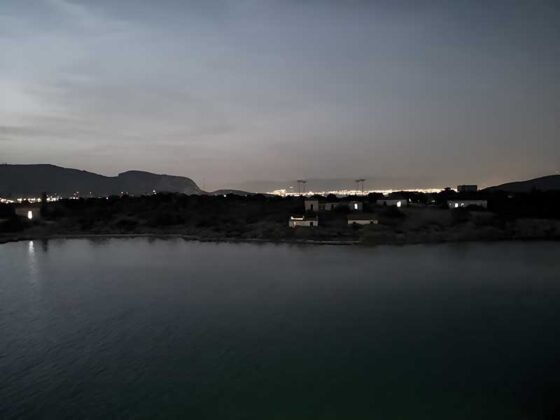
Ag. Giorgis Ph. Kostas Emmanouil: The abandoned houses of Agios Georgios island illuminated from within during Eri Dimitriadi’s xhibition. PHOTO: KOSTAS EMMANOUIL
In 1967, it passed under the authority of the Hellenic Navy and since then it has remained abandoned and inaccessible.
Dimitriadi was only six-years-old when she noticed the ruined and almost collapsed houses on the island while walking with her mother in Salamina, where she was born and raised. Her mother explained that isolated people with mental illnesses used to live there, and told her a story about an elderly patient who wanted to reach the opposite shore and tried to empty the sea with a clay basket.
That story never faded from her memory.
Decades later, after moving to Athens, Dimitriadi decided to explore the island artistically in an effort to preserve the oral history of this small strip of land which for decades had been a place of confinement and silence, and also to learn more about the man from the story she had heard as a child.
In 2021, she presented an unusual exhibition at sea on a ferry boat running between Perama and Salamina. The project was curated by Galini Lazani, whose support was instrumental during the development of the exhibition.
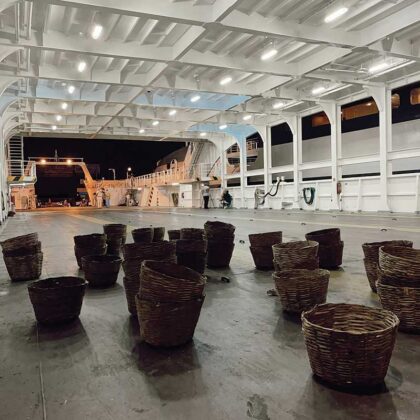
Clay baskets installed on the ferry deck as part of Eri Dimitriadi’s site-specific exhibition, referencing the story of a patient who tried to empty the sea with a basket to reach the opposite shore. Photo: Stamatis Koutsoukos
Through seven interviews she attempted to bring back the memories of local residents about Agios Georgios.
“Although the island has a long and complex history I chose to focus on the period when it functioned as an asylum,” she says to NEO.
“I was deeply interested in the story of the patient who wanted to leave the island and reach the opposite shore. With a basket, he tried to empty the sea so he could cross. When I heard this story as a child, I found it fascinating. His thinking was so direct. If I want to leave, I must empty the sea. I began to wonder why this way of thinking is considered less ‘normal’ than our own which is often far more confused.”
This reflection also inspired the title of the exhibition which references the linguist Edward Sapir. “both, as yet unwearied, will keep pretty well together.”
On the ferry visitors can listen through speakers to seven interviews with residents of Salamina, who shared their memories of the island of Agios Georgios. Scattered across the center of the deck were clay baskets that Dimitriadi had created herself as a tribute to the man who, according to local memory, tried to empty the sea with a basket. As the ferry approached the island visitors saw for the first time in half a century the abandoned houses of Agios Georgios illuminated.
“I chose the light to come from inside the houses as if they were lit from within,” she explains. “I did not want the conventional external illumination used for monuments whose history has already died. I wanted to give these buildings even for a moment the sense that life still existed inside them. I am an architect and these details matter to me”.
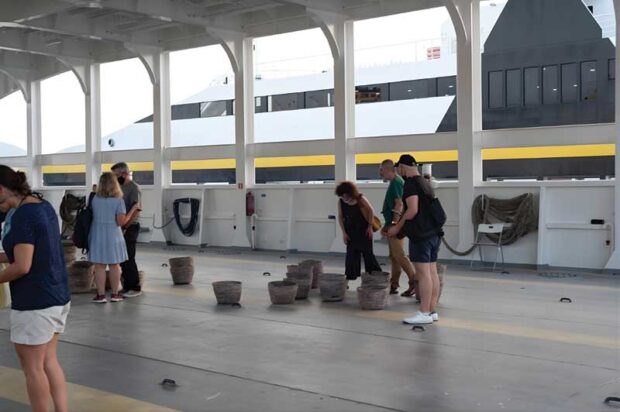
Visitors engage with Eri Dimitriadi’s installation on the ferry deck during the site-specific exhibition about the memory of Agios Georgios island. Photo: Stamatis Koutsoukos
The choice of a ferry boat was not accidental. According to Dimitriadi, the Perama Salamina route was the way residents used to encounter the island of Agios Georgios.
“The ferry route was the path through which the island and the people living there became visible to the residents of Salamina. To transfer this experience into a gallery space would have been like uprooting the story from its place”.
Memory as a connection to place
Dimitriadi hopes that the artistic intervention could one day acquire a more permanent character and expand in the future as an effort to preserve the memory of the place. As she notes, in recent years there has been growing interest in what are often described as “sites of memory” and in local histories that connect people with their roots.
“People increasingly look for their place. They want to learn how previous generations lived and to find a connection with the past.”
For her, the discussion around the project remains relevant even today five years after it was first presented. “It still makes sense to talk about this exhibition because it touches on many issues such as confinement memory and the distance between intention and action. At the same time, it is an oral history that risks disappearing.’’
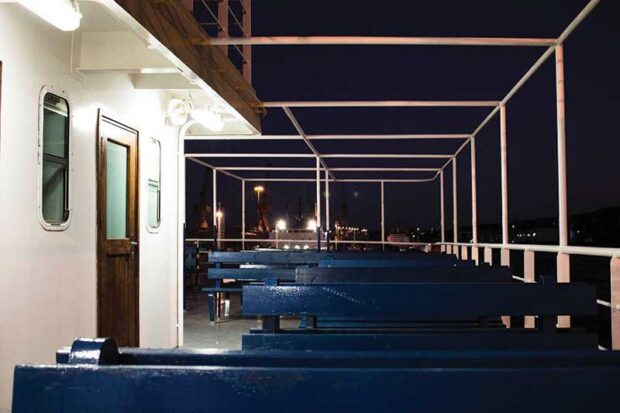
The ferry boat on the Perama–Salamina route that hosted Eri Dimitriadi’s site-specific exhibition about the memory of Agios Georgios island in 2021. Photo: Eri Dimitriadi
Her engagement with memory and place did not begin with Agios Georgios. In her thesis at the Athens School of Fine Arts she had already explored the so called “ship graveyard” in the harbor of Salamina, which she remembered from childhood as a landscape of abandoned vessels, that later disappeared before the 2004 Olympic Games.
Reflecting on her relationship with her place of origin, Dimitriadi says that distance often strengthens the need to return to memory.
“I left Salamina when I was nineteen years old in order to study in Athens. As long as I felt that I had an immediate connection to the place I did not observe it closely. But once I truly moved away, I began to look for it more intensely. When you leave you search more deeply for your roots”.
She believes that this need is closely related to the experience of diaspora communities.
“People who live far from their homeland often want to learn stories about it. In a way you are now searching for those roots on their behalf ,” she says.











0 comments