
- Leading HANAC: Stacy Bliagos on Community Service in New York
- The Hellenic Initiative Celebrates Record-Breaking Weekend in New York
- Building the Future: HANAC’s 53rd Anniversary Gala Honors Advocates for Affordable Housing and Community Care
- Leona Lewis: Las Vegas residency ‘A Starry Night’
- Emmanuel Velivasakis, Distinguished Engineer and Author, Presents His Book at the Hellenic Cultural Center
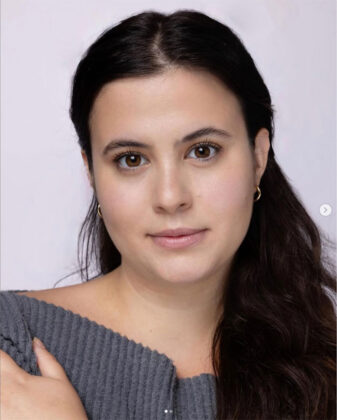
Powerhouse Actress Maira Bondre Takes NY by Storm
When any actor comes to New York, the place they want to visit is The Actors Studio, where Elia Kazan ruled, and Marlon Brando started a whole new school of acting, and every actor of note has studied there. And when Maira Bondre applied there, she heard back almost immediately–after coming from Greece and studying in England and while still wide-eyed in America.
“My very close colleague Stratos Eleftheriou came up with the idea that we go on their website and send them an inquiry,” she says, still breathless. “We’re actors in New York, we want to know how to be a part of the Studio—and they actually wrote back—and gave us a job! And working there is only the beginning—now I’m planning to audition and start my journey to become a full member!”
Which for Maira has been the arc of her meteoric acting career, that began with her first performances as a kid in Chalandri in Athens, to the National Theater of Greece, where she performed Andromache in The Trojan Women, Caliban in The Tempest, Family Stories on Alpha TV, which gave her national recognition, and then went to study acting in London—where she auditioned for the venerable Royal Academy of Arts.
“So it was a very good audition,” she remembers, “and we had a whole conversation about my previous roles, and they seemed very interested. Only the last question was: How old are you? And I told them seventeen—but the minimum was twenty-five!”
So she had to wait on that, but she did get into the equally-prestigious East 15 Acting School (where many of the familiar faces in British theater and cinema have come from), through which she did several shows, including Bertolt Brecht’s The Good Person of Szechuan, and also got to perform for Queen Elizabeth at her Platinum 70th Jubilee—as a pansy.
“It was a pageant, with many dancers and performers, and a huge maple tree in front leading a field of pansies—and I was a giant pansy flower,” she says.
And besides the queen and the royal family (“The Queen would come out and wave to people—and I saw the royal family sitting in the bleachers and waving to everybody!”), Maira got her biggest audience so far, because the Jubilee was not only broadcast all over England, but all over the world to an audience of countless millions.
“It was a whole pageant,” she says.
But her dream, though, was still to come to America.
”I had been thinking about that since high school back in Greece,” she says, and now lives in Brooklyn. “I had always wanted to study and work here. I love Broadway. I wanted to see the theater scene. I wanted to expand my studies and experience as much as possible. And in New York, anything is possible.”
Her mother, Fay, came from Greece to help her settle in, and when she left, Maira had to learn for herself how to do those “serious adult things.”
“They sound very simple—” she laughs “—but to me they seemed like this huge task—like going to the bank, like paying my rent—those were my worries at the beginning! I remember calling my dad and almost crying: ‘Dad, I don’t know how to write a check!’”
Fortunately, she learned, while she began her studies at the New York Film Academy, where, ironically for a theater kid, she first did a couple of films, often playing leads.
“They have a filmmaking program at the school, and a directing program,” she says. “And the directing students are always doing projects to get hands-on experience, and they need actors for those projects, so they come to us and we become a part of their films. So I got to work with a lot of great directors inside the Academy—that were also my teachers. I really enjoyed my first year at the school.”
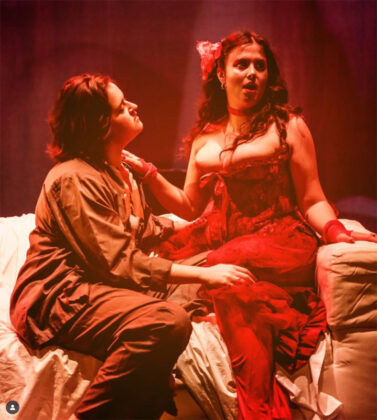
And then after graduation, the inevitable audition process began, but she was able to get a leading role almost immediately in a new play by Dimitri Michalakis called The Visit of Mother Moses—her first theater credit in America. Which would seem to be totally outside her realm of experience—it’s about former slave Harriet Tubman and her abolitionist friends during the Civil War—and yet Michalakis says Maira was a powerhouse on stage playing one of the daughters.
“She dominated the stage,” he says. “She delivered the lines like they were her own, and she was Ellen Wright, the haughty daughter who had grown up a Mormon in Auburn, New York and had worked with her mother to fight for abolitionism and women’s rights all her life: she was a revelation.”
So what’s in her limitless future?
“I feel like this is just the beginning stage of my career,” she says, “and I’m very happy with everything I’ve done so far, but I want to wake up every day and work in the theater: I want to go as far as I can in this industry. I want to work in the theater, dream of going on Broadway, and being in a big show, and getting my work recognized. That would be amazing—but also to keep working on my art and become the best artist I can be.”
As for her Greek background?
“I’m very proud to be Greek,” she says, “so any chance I get to show my roots and show people through my art what it means to be Greek would be wonderful. I did ancient theater, and I would love to do it more—because the last time I did it I was very young. I would welcome any chance to show my roots through my art.”
She is, in fact, working on a number of other projects with Michalakis, a film series shot on the streets of New York about two young and aspiring Greek immigrants called Lost in America, a play about a young Greek immigrant working in the upscale homes of Greek American society while making a life of her own called America America, and another play called Greek Radio, about the lives of various Greek Americans as they go through their day listening to Greek radio in the background.
“And I would love to direct something at some point,” she says, dreaming big, even though she is only 24, but already making her mark in America. “I love all aspects of the theater, I want to be an actress, and I want to do everything!”










0 comments